My ancestors came from both Sweden and Bohemia, settling in Iowa. Through this blog I hope to share information with my own relatives about my Swedish ancestors. Please comment or share any interesting and relevant information you have on this family line.
Showing posts with label Carl Johan Lundblad. Show all posts

Tuesday, July 4, 2023

So Many Questions

I love being a genealogy detective, a family ancestor searcher. Sometimes I tell people that I sit at my computer "finding more dead people," but the truth is that I love the stories of their lives. And while I enjoy learning about our ancestors' lives, they continue to intrigue me with the facts, the stories, the problems that are left out.

Catherine Lundblad Linn, my second great grandmother, was born in 1823 in Sweden and died in 1912 in Iowa. She was the youngest of 3 children born to the soldier Carl Johan Lundblad and his wife Maria Andersdotter. Catherine and her husband Gus and oldest son Johan came to the United States in 1852, settling in Iowa near Gus' older brother John Linn.

Catherine's older brother Anders Carlsson Lundblad (1819-1908) was married in Sweden to Anna Catarina Johansdotter and they had 6 children in Sweden before they left for the United States in 1857. In Iowa they had 6 more children for a total of 12.

The oldest of the 3 children was Maria Carlsson Lundblad, born in 1816 and died in 1900. Wherever I find Maria, at whatever age she is, Maria was unmarried and working as a laborer on various farms. In the last clerical survey where I find her alive, Maria is living in the poor house, noted as the Fattighus below. Maria is the 5th entry below.


Maria, Anders, and Catherine's mother had died in 1838; their father in 1841. The 3 children were all adults and should have been capable of making their way. 

Maria had a long life, living until age 83 when she passed in the poor house. Her brother Anders and sister Catherine were both 88 when they died in Iowa.

Does any of this raise a question? For me, it does. Catherine and Gus came to the United States in 1852. Anders and his family came in 1857. Why didn't either of them take sister Maria with them?

Perhaps she didn't want to leave Sweden. Perhaps there were physical or mental issues that made taking her very difficult. Perhaps Catherine and Anders had lost contact with her as Maria moved from farm to farm for work. 

Below is Maria's death record for 1 May 1900. She died of old age in the poor house.


This is just another mystery in the family.

Saturday, October 13, 2018

How They Died

What do we know about how our Swedish ancestors died? Do we have any common illnesses, genetic issues, that we should know about?

The Swedish death records, depending on the parish priest's interest in writing a proper obituary,  sometimes contained elements of our ancestors' lives, hints about other family members, and sometimes the cause of death. Here are just a few from our ancestors:

One of my 7th great grandmothers, Anna Larsdotter, an ancestor to Maude Edith Olofson, was born on March 11, 1694 in Farila Parish, Gavleborg County. Her death record states the following:
Farmer's daughter, Anna Larsdotter, born in 1694, on March 11, was the daughter of the farmer Lars Mansson of Fone, and her mother was Karin Olofsdotter. She was married in 1721 and had 6 children -- 4 sons and 2 daughters. She was a widow as of March 28 of last year She had good health, but in the last year she was in mourning. She probably laid on her soft bed as she was taken with grief. She died at 80 years, 10 1/2 weeks.
What wonderful hints about her, her husband and his death, how many children to research and follow.

 A 7th great grandfather, also on the Olofson line, was Olof Ersson, who lived from 1666 to 1747 in Farila Parish, Gavleborg Parish. His death record indicates that he "lived with his wife of 50 years who is still living. They had 5 sons and 3 daughters. He lived an honest life but was in weak health and died of rheumatoid arthritis on Sunday, April 27, 1747, at the age of 81 years and 4 months."

From this record, we learn that his wife is still alive; how many children, in case we've missed any, how old he was so we can trace back to his birth record if we don't have it.

Going to the Linn ancestors, my 4th great grandmother Greta Carlsdotter, mother-in-law to Olaus Fredricsson, has the following obituary that contains several hints for research:

Greta Carlsdotter from Amundarp died June 24, 1823. She was born in Edshult on December 15, 1764. She was married in 1782 to the farmhand Jonas Mansson and was widowed in 1788. Mother in this marriage to two daughters, both of whom are living. She married in 1793 to Corporal Johan Tomt and with him conceived 4 children, 3 sons and 1 daughter, who are still alive. She died at age 58 years, 6 months, and 9 days. Cause of death was pain.
Greta married twice and had a total of 6 children to follow. Her second husband, Johan Tomt, a military man, is also someone to follow as Sweden was at war during this time.

Carl Lundblad, Catherine's father, and my 3rd great grandfather, died on August 17, 1841, at the age of 47. His death record below shows that he was from Saxebacken, was a lifegrenadier from Skarlunda, born in Tidersrum Parish in 1793, married to Anna Stina Jonsdotter (his second wife), and had 1 son and 2 daughters. He was buried on August 22. He died of "slag" or a stroke.

Notice all of the elements of his life in this short death record that a researcher can use to follow other people, to find a birth, to find his military record, and more.


And then we run across a husband and wife, my 5th great grandparents, who died within 6 months of each other. Maria Ericksdotter, of Stromskullen in Malexander Parish of Ostergotland County, and her husband Olof Ekstrom of the same place are Linn ancestors, Catherine Lundblad Linn's great grandparents. This one threw me a bit when, last November, I was sitting at a computer in Salt Lake City just after the opening of the library. I had Maria's death record pulled up on the screen. She died June 15, 1799, buried on the 23rd. She was 75 years old. But then the library computers all froze, and all I could do was stare at the page on the screen, but not translate anything using the library online dictionaries. I wanted to know what Maria had died of. It's in the far right column below. And so, while waiting for the power to return, I used a translate feature on my Iphone and entered what I thought I could read of her cause of death: "venerisk sjekdom".


I'm quite sure that I uttered something when my Iphone translated those Swedish words into English. Venerisk sjekdom means venereal disease. My 5th great grandmother. 1799. What?

When the computers were working again, I hailed THE BEST Swedish researcher at the library and asked him to look at Maria's death record and tell me what her cause of death was. He said "venereal disease". I had to ask if that meant what I thought it did and he assured me it did. He said it was probably syphilis, completely untreatable, and a painful and prolonged way to die.

Shock. Just shock. Then sadness that she suffered so. Then anger. What about her husband Olof Ekstrom? I found his death on the same page.

Olof Ekstrom died on December 5, 1799 and was buried on the 15th. He was 70 years old. And he died of breast fever, known as pneumonia.


Well, something doesn't add up. Either Maria contracted syphilis from someone other than her husband, or Olof died of pneumonia before the syphilis killed him. They probably both suffered quite a bit and were in a great deal of pain.

Whether the diagnosis at the time was accurate, I don't know. Whether there are other plausible reasons for Maria's disease, I have no clue. It is clear from the record above that, in 1799, her diagnosis was venereal disease. But, I leave any possible interpretations to you.

Our Swedish ancestors died of many different diseases, from influenza, to TB, to pneumonia, to cancer, and venereal disease. There were horse, car and work accidents, old age, and the death of small infants, not able to survive. I've not found a single cause of death to warrant our being concerned about a specific illness or genetic problem.

The details of our ancestors' lives are what puts the meat on their bones. Last week's post was about the "boring begats" that turn many people off. But don't you think that this was an interesting look at some of our ancestors?

Sunday, August 12, 2018

Treatment of Our Poor Swedish Ancestors

Just like most families, we have had our share of ancestors who were unable to care for themselves. And, as you might expect, family members often helped one another in Sweden, taking in their poor relatives or finding a way to care for their basic needs.

In Sweden before the mid 1800's, the poor were cared for in the following way:

  1. Relatives were to care for their poor family members when possible.
  2. Parishes were directed to build a facility to house the poor, but in rural Sweden, this was often not done.
  3. Without a facility, members of a Parish Board made a list of the paupers in their parish, and the paupers were assigned to a place in that parish that was responsible for the pauper.
  4. The pauper was given a piece of wood on which the names of the various farms in the assigned area were written and the amount of time a pauper could stay at each location. Food and clothing and shelter were provided before the pauper then had to move on to the next location.
In 1847, a Poor Relief law was passed to standardize care across the entire country. And under this law, the following additional rules were added:

  1. Only those unable to work, who could prove they were from that specific parish, and whose relatives had exhausted their ability to help were eligible for relief from the parish.
  2. If a person moved out of the parish, the new parish would NOT care for the person until the pauper had lived in the new parish for at least 3 years. This discouraged people from moving just to receive aid.
All of this probably seems reasonable. But added to this were the "pauper auctions" in which an individual or a family would "bid" on a pauper who would be under their care. Bidding was kept as low as possible because the family winning the "bid" and providing the care would receive a stipend from the Parish Board to provide food, clothing and shelter to the pauper. This was clearly a money-making effort on the part of some Swedes.

And so, in some places there was a centralized poor house. In others, the poor were given a piece of wood with the names of various farms they could stay in for a short time before moving to the next. And in other cases, paupers were "bid" on and often mistreated as the care was kept to a minimum to increase the profits a family might make off of the care.

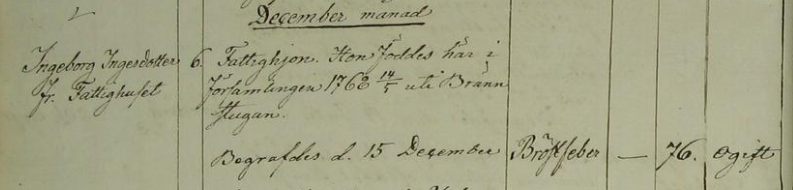
My 4th great-grandmother, Ingeborg Ingedotter, became one of the paupers who needed care. She was the mother of Carl Lundblad, and the grandmother to Catherine Lundblad Linn (Gus Linn's wife). Ingeborg was born in 1768 in Malexander Parish in Ostergotland County. She gave birth to Carl, her only child, as a 25-year old unwed woman, and she never married.

For a time in the 1820's and 1830's she lived with her son Carl and his family, but when Carl's first wife died and Carl remarried in 1839, Ingeborg left.

I don't know her experiences as a poor person in Malexander Parish. But based on what I do know about the Swedish poor laws and what I've seen in clerical records and her death record, I would guess that Ingeborg was one of the people who roamed from farm to farm with a piece of wood that was provided by the Parish Board. Her death record below states that she died in the poor house in Malexander and came there from Brannstugan farm where I find NO record of her ever living. Ingeborg also died before the change in laws in 1847 that included "bidding" on paupers. Thus, I feel confident in my guess. 

I picture Ingeborg walking from one farm where she had received food and shelter to the next farm listed on her piece of wood, walking on dirt roads during very cold Swedish weather, a woman in her 70's. It's a visual that is hard to get out of my head.

I wonder about Ingeborg's life. From a single mother who never married, to living with her son until he remarried and may have felt she needed to leave, to roaming from farm to farm with a piece of wood that told her how long she could stay in each place, having to rely on parish members for food and shelter, to dying in the Poor House, she seems so very sad and alone. 

Every ancestor we have can't have a story that is only positive, only happy. I hope that Ingeborg took great pride in the one son she raised, a son who was a soldier. I know that I'm thankful for the gift of his life and for what that meant for those of us who follow.


Ingeborg Ingedotter from Fattighushet (poor house) died December 6, 1844; born May 14, 1768 and came from Brannstugan. She was buried on December 15 died of a breast fever (pneumonia) at age 76 and never (o) married (gift)

Sunday, May 20, 2018

Catherine's Older Brother


Until I started this blog, I hadn't looked at Anders Lundblad very closely other than locating his birth and death and his marriage to Anna, plus a few details about their children. But after writing about Catherine and involving Andrew a bit in her story, off I went to find out more about him and his family. And a large family it was!

The only son of Carl Johan Lundblad and his wife Maria Andersdotter, Anders Carlsson (later known as Andrew Lundblad) was born on Saxebacken farm in Malexander Parish on September 21, 1819.

In the postings about his sister Catherine, we know that Anders left home when his father remarried, working as a laborer on various farms in Malexander Parish. He met Anna Catharina Johansdotter whom he married on December 27, 1844.

The couple had the following children in Sweden:

·         Anders Johan Alfred Lundblad (later known as Alfred), born August 6, 1845;
·         Carl August Lundblad (later known as Charles), born March 25, 1848;
·         Anna Charlotta Lundblad (known later as Charlotte), born May 14, 1850;
·         Hedda Matilda Lundblad, born July 12, 1852, and died March 17, 1856;
·         Maria Lovisa Lundblad (known later as Louisa), born July 19, 1854;
·         Gustaf Melker Lundblad, born June 20, 1856, and died April 14, 1857.

As we learned from the post two weeks ago, Andrew Lundblad and his family immigrated to the United States in 1857. We see them in the moving out records to North America on April 14, 1857. Does that date mean something? When we look at the date 9-month old Gustaf Melker died, they are the same. I had to look several times at the records to be certain I had it right. And I did. When I reviewed Gustaf’s death record, I see that he was buried on April 26, days after the rest of his family had left for North America.

As usual in genealogy research, one item often brings up additional questions or confusion. But I remind myself that the lives our ancestors lived were not the same as those we live today. Were the wheels in motion for sailing before Gustaf died? Tickets purchased? Travel arrangements made? If so, there was little choice this family had but to leave when scheduled. And one other thought: Today we have hospitals and doctors and medicine and tests that reduce child mortality tremendously. But it was not unusual for families to lose several children to what seems to us to be simple diseases. In this case, Gustaf contracted pneumonia, and his 9-month old body could not overcome that. It was just a very sad fact of life.

There was no time for grief. No time to bury their son. And so, Andrew and Anna Lundblad, along with their two surviving sons and two daughters, sailed in steerage for North America, arriving in Boston on July 3, 1857. Once settled in Pilot Mound, near his sister Catherine and her husband Gus Linn, they had more children:

·         Augusta Lundblad, born July 27, 1859;
·         Anna Julia Lundblad, born July 23, 1861;
·         Henrik Julius Lundblad, born July 28, 1866;
·         Edward Lundblad, born in 1868;
·         Maria Lundblad, no birth date known
·         William Lundblad, no birth date known but he died August 22, 1869.

Just like Gus and Catherine, Andrew did well for himself in this new country. He became a citizen and owned his own farm. In the 1870 Federal Agriculture Schedule, we see that the family owned 160 improved acres, 10 unimproved, worth $5,000 total. Machinery and farm implements totaled $250. They owned 8 horses, 7 milch cows, 6 working oxen, 13 other cattle, 11 sheep, 16 swine. They had 750 bushels of spring wheat and 3,000 bushels of Indian corn, in addition to other produce.

Looking at this family over the next several years, I find no news articles other than the usual "newsy, homey" kinds of articles about visiting neighbors or going to town. They led a quiet life, but one that clearly centered around their children. 

ARTICLE FROM DES MOINES REGISTER, JAN 5, 1905: Their 60th Wedding Anniversary
PILOT MOUND, IOWA Jan 5 several relatives and kind admiring friends met at the pleasant home of Mr. and Mrs. Andrew Lundblad on Tuesday, December 27, to assist them in celebrating their 60th wedding anniversary.

Mr. and Mrs. Lundblad are pioneer settlers in this vicinity, coming to this country from Sweden in the early days and when the country was almost a wilderness, enduring all the hardships imminent to the life of a new country, and with the patience, determination, perseverance, bent all their energies to build up the happy home they now enjoy, surrounded by scores of kind friends and acquaintances.

It has been the writer's privilege to live a near neighbor to this illustrious couple for many years and they have always been ready to grant any favor of accommodation in their power. Many are the kind deeds that can be attributed to their willing hands, many the kind and encouraging words spoken by them to cheer, comfort and encourage their friends in diistress and trouble.

This venerable couple have seven children to comfort them in their declining years. Alfred Lundblad, Mrs. Charlotte Peterson and Mrs. Augusta Bergendahl living in Pilot Mound Township, C. A. Lundblad, Mrs. Mary L. Nelson and Miss Julia Lundblad, living in Dayton, Iowa, and Henry Lundblad, who lives near Laurens, Iowa.

Ten years ago this couple celebrated their golden wedding anniversary. At that time there were present seven children, twenty-three grandchildren and many friends. They now have twenty-eight grandchildren and twelve great grandchildren.

While this couple is quite aged, they are enjoying reasonably good health. Mrs. Lundblad doing her own housework, and Mr. Lundblad does light work and his own chores, while when the weather is fine, they drive eight miles to church.

Heaven has bounteously lengthened out the lives of this venerable couple and their many friends pray that the Father of all mercies will smile on their declining years and bless them.

✸✸✸✸✸✸✸✸✸✸

UNSOURCED INFORMATION: In 1894 Andrew and Anna celebrated their golden wedding anniversary. The Dayton Lutheran Church presented him with a gold headed cane and her with a gold band ring. After his death the cane went in turn to Alfred, Charlie and Henry and now is with Henry's son, Frank. The ring is with Charlotte's daughter, Callie Huglin.

NOTE: Wouldn't it be fun to see those two items? I hope they are still in their family.

✸✸✸✸✸✸✸✸✸✸

Anna Lundblad died on January 18, 1907, at age 82 and is buried in the Linn Cemetery. Husband Andrew Lundblad died a year later on February 23, 1908, at age 88 and is also buried at the Linn Cemetery.

Andrew, Catherine, and Maria, the three siblings, all died at the age of 88. An amazing fact!

Obituary in Dayton Review, January 31, 1907,
page 4

Obituary in Dayton Review, March 5, 1908,
page 1


Sunday, April 29, 2018

Caterina Lundblad

Augustus (Gus) Magnus Olausson Linn. Father, husband, brother, farmer, Civil War veteran. We know the details of his life through photos, stories, news articles. Even his obituary appeared on the front page of the Dayton Review.  The cane he whittled while he was a POW is still in the family.

But what about his wife? What do we know about the woman he married in Sweden? The mother of his children? The person who stayed on the farm during the Civil War raising the children and taking care of the farm responsibilities while Gus served our country?

For the next two weeks I will share what I have learned about Caterina (Catherine) Lundblad, my second great-grandmother.

When following our female ancestors, it's important to know that there is not as much information about women. Women were referred to by their husband's names in news articles i.e. Mrs. John Smith and not Mary Smith. In the United States, a woman's maiden name was gone after marriage until it sometimes appeared in an obituary. And until our more recent history, women didn't own land, vote, serve in the military, or work outside the home or farm. It can be a real challenge to find interesting or detailed information about our female ancestors.

Caterina Lundblad was born on October 3, 1823, on Stromskullen farm in Malexander Parish to the soldier Carl Johan Lundblad (1793-1841) and his wife Maria Andersdotter (1793-1838).

Catarina Carlsdotter from Stromskullen born October 3, christened October 5, 1823. Parents Life grenadier Lundblad and wife Maria Andersdotter

Carl was born to the unwed mother Ingeborg Ingedotter. His military record states that he represented the Skarlunda rote, serving as a "life grenadier" in Omberg Company. A grenadier was originally a soldier armed with hand grenades. The grenadier first fired his musket and then he would light the fuse of the grenade and throw it, a seemingly dangerous job. By the time Carl Lundblad was in the military, though, a life grenadier was simply a part of an infantry unit. Carl was 173 cm tall (just under 5'7" tall) and was in the military from 1813 until his death in 1841.

Carl's service included time in both Germany and in Norway from 1813-1814. And on a closer look at Swedish military history at that time, it appears that Sweden fought a major battle in Germany in 1813, and in 1814 was at war briefly with Norway, both of which were victories for Sweden. It is likely that Carl saw action in both of these countries.

Carl and Maria married on October 19, 1815, in Malexander Parish, and had three children:

  • Maria, born on September 24, 1816; 
  • Anders, born on September 21, 1819; 
  • Catarina, born on October 3, 1823.

In Sweden during the early 1800's, it was normal for young boys and girls to make their own way, often leaving their family farm in their early teens to work as a servant or farm laborer. Sometimes family circumstances rushed children into their independence. In Catarina's case, her mother Maria died in 1838 and Carl remarried in 1839; shortly after, each of the 3 children left. Katerina/Catherina was just 16 years old, now working on various farms through Ostergotland county. In the clerical surveys, she is noted as "Catherina Carlsdotter" or "Katerina Lundblad" or "Carin Lundblad" or other variations of these. In order to make certain I am following the correct person, I always verify the birth date, birth location, and other information available, i.e. moving in or out records, name of parents or siblings.

It's interesting to note that, when Gus' father Olaus Fredericsson died, and his mother remarried, Gus and his siblings also started working on various farms. In Gus' case, he was just 9 the first time he is seen working as a farm laborer.

Catarina's father, the soldier Carl Johan Lundblad, died just two years after remarrying, passing on August 17, 1841, of a stroke, at the age of 47. In his probate, completed just one week after his death, it's clear that Carl had not amassed any wealth. And, as was the practice in Sweden at this time, the widow received half the estate, the children the other half, with boys receiving twice what girls received. None of the children became any better off financially from the proceeds.

Catarina and Gus met and married in Vastra Ryd Parish in Ostergotland County on February 18, 1851. Catherina was 5 1/2 years older than Gus. Their first child, Johan August, was born on August 30, 1851.  On April 11, 1853, Gus, Catarina and Johan set off for the United States, to join Gus' brothers John and Peter in Iowa, arriving in Boston August 10, 1853. On the passenger list for the Bark Christina from Gothenburg, Gustus is listed as Ustaf Olson, age 24, farmer; along with wife Catherine, age 29; and son John August, age 1.

Catarina was nearing 30 years of age when she left Sweden with her husband and son for the unknown. Her parents were both deceased; she was separated from her two siblings; she had worked for years as a servant girl until meeting and marrying Gus.  The clerical survey notations for both Gus and Catarina as they prepared to move to America in 1853 were that he was honest and there were no complaints and that she was honest and steady.

Gus and Catarina would have no opportunities to own property in Sweden, no parents on whom to rely. But what would they find when they arrived in Iowa? The hope of a better life drove them to make the arduous trip in Steerage, a most inhumane condition where people were crammed into tight quarters below deck with no food and little air. But would they find the better life that they dreamed of? Would the trip be worth the risk?

Gus had two brothers waiting for him and his family, but Catarina had no one. No one in a country where the customs and the language were different from her own. No one in a prairie state where her nearest neighbor might be miles away. Would either of her siblings join her in Iowa? Would Catarina be able to find happiness in this new place called Iowa?

Next week's post will look at Catarina in her new country.