My ancestors came from both Sweden and Bohemia, settling in Iowa. Through this blog I hope to share information with my own relatives about my Swedish ancestors. Please comment or share any interesting and relevant information you have on this family line.
Showing posts with label John Linn. Show all posts

Wednesday, September 20, 2023

Linns From A to Z

Once again, I'm just poking around my ancestral tree, looking for an interesting ancestor or someone I'd like to know more about. While looking through all of the Linns in my genealogy program, I counted 141 with the surname LINN. And this 141 doesn't count those who married into the family and took the Linn name.

There are 3 with the first name Mary; 3 with the name Maria; 4 Donalds; and the winner is John with 7. My list of Linns starts with my cousin Alan and ends with my 2nd cousin, twice removed, Zona Linn. Since Zona is an unusual name, I decided to take a closer look at her.

Zona was born in Minnesota on 28 April 1902 to Louis S. Linn and his wife Florence Stafford, their second child. Shortly after Zona's birth, her mother Florence died. Louis remarried in 1910 to Anna Brockman, who brought 3 more children to the marriage.

The name Louis S. Linn may mean nothing to us, but Louis' parents should sound familiar. Louis' father was Lewis Linn, the stepson of John Linn. Lewis took the last name Linn when John married his mother Sarah Svensdotter. Lewis enlisted in 1863 to fight in the Civil War. He joined the regiment at Athens, Alabama, where he remained for six weeks and then started with Sherman in his memorable march to the sea. He was in two engagements with Sherman in the Carolina campaign. He was later transferred to the 7th Iowa Infantry. He was twice wounded in engagements, and this permanently disabled him. He was mustered out of the service about July 1865 with a most creditable military record.

While Lewis Linn is not a direct ancestor, his wife certainly is. Kerstin Olofsdotter is my 3rd great aunt and sister to my 2nd great grandfather, Olof Olofson.

Back to Zona. In 1920, at the age of 17, Zona married Delbert Rouch, age 25, in Michigan. This marriage, however, didn't stand the test of time as they divorced sometime before the 1930 census. The divorce probably happened before 1925 as I find Delbert Rouch, a carpenter, living by himself in his home state of Indiana. And, in 1930, I find Zona, divorced, working as a telephone operator and living by herself in Minnesota. 

In 1933, Zona marries Thomas Tomek, an orchestra musician of Bohemian descent, who was 7 years Zona's junior. I would venture a guess that Thomas played in a Czech group that played polkas around the Midwest. For a time, they lived in Chicago which had a large number of Czech/Bohemian families.

While it doesn't appear that any children were born to this couple, they had a long marriage until Thomas died in 1987 in Minnesota. Zona passed in 1992. Both are buried at Saints Cyril and Methodius Catholic Cemetery, Taunton, Lyon County, Minnesota.

So, like most of us, Zona Linn lived a normal, but fairly unremarkable life. Still, I'm happy to share her with you and keep her name alive.


Zona and her brother Lyle were from Louis S. Linn and Florence Stafford Linn's marriage.


Monday, August 21, 2023

The Land They Bought

Many immigrants came to the United States for the opportunity to own land. In Sweden, with the exception of just a couple of my ancestors, none of the Linns, Olofsons, Barquists, Anderssons, Rasks, and others were able to own a piece of land. While there are other reasons for migration (religious freedom, escape military service, and more), being able to own land was a very important reason for our ancestors to leave their family, friends, and homes.

Here is just a brief look at some of our ancestors' early land purchases:

Peter and Sophia Linn: Arrived in Iowa in 1851.

Through the Bureau of Land Management, they purchased 40 + 20 acres of land in Boone County on June 5, 1866. Township 85 North; Range 27 West, Section 3. Link here: Description of Land

Gustus and Catharine Lundblad Linn: Arrived in Iowa in 1853. By 1855, Gus and Catharine were buying and selling land.

One early transfer of land  on 24 May 1855 when Gus (grantor) to Peter Runyan (grantee), a man who had been born in 1787 in New Jersey and had made his way to Iowa and Boone County where he died in 1871. 

Also in 1855, Gus was on the purchasing side of land on 14 August 1855 from Andrew Kaulson; and on 4 September 1855, Gus sold land to Charles Munson. 

John and Marget Barquist: Arrived in Iowa in 1858.

Through the Military Scrip Warrant Act of 1855, the Barquists were able to purchase land along the Des Moines River that had been gifted to a Civil War soldier as payment and appreciation for his service. The 160-acre Barquist land in Webster County was bought on June 1, 1866. Township 86 North,  Range 27 West, Section 23. Link here: Description of Land. As you may recall, this is the land that was forcibly taken from John and Marget with the lawsuits going to the US Supreme Court for a final decision.

 John Linn: Arrived in Iowa in 1849. 

I'm not quite certain when John and Brita OR John and Sarah bought their first land, but on 3 May 1856, John and Sarah sold land to the School District of Hardin Township in Webster County for $10 to be used  to build a school. It was in Township 86, Section 26, Range 27 and contained 80 square rods which computes to half an acre.


The above plat map for Dayton and Hardin Townships was from 1909, much later than the sale of land in 1856. The owners of land clearly are not the same as they would have been in 1856. But we can see the Des Moines River and, to the right, sections 27 and then 26. It is in Section 26, around the name Berglund, that the school would have been built.

An accounting for the school shows that John Linn continued to support the school by giving money to a teacher fund, being paid $1.30 for a bucket and a tin cup for the school (1860), being paid $2.00 for work and lumber furnished for the school house (1860). This information was all found in a very brittle book on the accounting of the Hardin school. 

In 1859, I also show John Linn owning 80 acres in Section 27 of Hardin Township. For a time, he co-owned it with a man named Frederick Carlson, no relation that I can determine.

While these are just a few of the early purchases of Iowa land by our ancestors, many were busy buying and selling land during their first few years in the state. Through assessor's books, BLM online information, news articles and plat maps, I have put this brief look together. I hope it gives you an appreciation of our ancestors' desire to own land and become part of their communities.


Friday, May 26, 2023

Sarah Svensdotter Linn's Obituary

Can you handle just one more obituary? Shortly after I received John Linn's obituary translation from the librarian I've been working with, he sent me this one last obituary. This one is for John Linn's second wife, Sarah Svensdotter. Again, the translation is a bit rough, but still worth reading for a more complete understanding of this couple and their work:

 January 10, 1900, Mrs. Sarah Linn

Pastor John Linn's wife, born in Ulrika Parish, Ostergotland County, Sweden, on 3 December 1820 and died in Stratford, Iowa, on 29 December 1899 at the old age of 70 years and 26 days.

She married and immigrated with Anders Hennrik Jakobsson Somberg in 1851 and stayed in Chicago where her husband died of cholera in October 1853. She arrived with her two small children Melker and John in Swede Bend, Webster County, Iowa,  and on Christmas Day, 25 December, she entered into marriage with John Linn. Their marriage was blessed with 5 girls, of which the youngest [Laura] crossed the river to a better world. She leaves a husband, 8 children, 26 grandchildren, 5 great-grandchildren who [mourn her loss]. 

The parish in Swede Bend was formed in 1854 and she was among the first to join it. For over 45 years, she was a member of the church, actively serving until her health began to fail. Even then, her husband visited their children in November, hurrying back in December as her suffering became too much to bear. 

During her suffering, there was no sadness. She raised her hand and said "I am near home." And she wanted assurance that she would see her children and grandchildren in heaven. When Mr. Linn greeted her from one of her daughters, the daughter replied by letter, "It is certain." 

Mrs. Linn has followed her husband to many locations in Illinois and in Iowa, including Moline and Rockford, Des Moines, Sheldahl, and Stratford.  She was loved by the congregations wherever she was, hospitable, and welcoming to people her husband would invite to their home.

Peace to her good memory.

This translation had several difficult parts to translate, but I hope you have the essence of what the writer was trying to tell us about Sarah Svensdotter Linn. 

I found each of these memories to have contained details about their lives that I'd not known. They have given me a fuller picture of who they were, their devotion to the work of the church, their unwavering faith, and their love of family. 


Laura Linn had already died when this photo was taken. These are the 4 remaining daughters of John and Sarah Linn as well as Julia and Mary born to John and his first wife Brita.


Monday, May 22, 2023

John Linn's Memoir

My last post contained the memoirs/biographies for Peter and Julia (Linn) Berg and Peter's second wife Adelia. When I wrote to the librarian to thank him for his help, I asked if there might be something similar for John Linn. He quickly sent back the following, contained in the Western Swedish Conference Journal from September 1907, just 3 months after John's death.

And, before moving on to this translation, perhaps you were as confused about the use of the word "memoir" to describe the passages we have been reading. It appears that we have a translation issue or language barrier. John Linn's "Memoir" is actually translated "Memory Drawing". To me, that seems more like someone's memory of a person, like an obituary or a short biography. See what you think in the following:

Below is a rough translation of John Linn's very lengthy Memoir:

John Linn is dead. That was the message. How could he die, he who, though the oldest among us, could not even grow old? But still he is dead, the youthful, lively, vigorous veteran. He still lives, however, not only in the abode of rest, but also with us in the work he did, the congregations he founded, the seven children who, through him, have been helped on the path of life. John Linn was born on 29 May 1826 in Linkoping County, Sweden. In early childhood, he lost his father and, like David of old, had to begin the school of life by herding sheep.

After many challenging experiences, he emigrated to America and arrived in Chicago in the fall of 1849. Cholera broke out there, in which 12 of his traveling party died. From there, the others went through St. Louis and Keokuk to Swede Point, Iowa, which was the destination of the voyage. There, Linn's only child died of smallpox. The land on which they intended to settle was already occupied by others, and they continued their journey to the northwest, where the present-day Swede Bend, Iowa, and present-day Stratford were and built their log houses along the banks of the Des Moines River and began to cultivate the land. It was here that he was converted to God. It was also here that his first wife died in 1853 and his second wife in 1899 and here in this place he himself fell asleep on 17 May 1907. 

Concerning his conversion, Brother Linn told us that a Swedish Methodist preacher named Smith was sent from New Sweden, Iowa, to the settlers at Swede Bend to preach the word of God. A certain Andrew Adamson proposed that a meeting should be held, but expressed that the preacher was one of the worst, one of the miserable Methodists! Brother Linn replied that he would hear him even if he were a Catholic! So, he came to the meeting and took his seat under a tree. The text was John 10:11 "I am the good shepherd, etc." During this sermon, God spoke peace to his heart, whereupon he immediately arose and held according to what he himself thought, gave a class with Andrew Adamson as exhorter and John Linn as class leader. This was his first office within the church. He had unspoken preaching authority by Peter Challman. In 1860, it was recommended that he take up the travel system, but as the support was too scarce, he had to leave there for the sake of his family.  

He was ordained deacon in 1858 and sent to Moline, Illinois, and later Bishop Janes ordained him and sent him in 1871 to Rockford, Illinois. The next place was Galesburg, Illinois, where he worked successfully for two years and managed to pay off a rather pressing church debt. He was then appointed presiding elder over the Iowa district, which then included not only that state but also Kansas and Nebraska. At the same time, he was the minister in charge of Des Moines, even though there was no church or congregation. It was during his four-year term of office that most of our congregations, both in Nebraska and Kansas were founded. 

Due to his own and his wife's broken health, Brother Linn requested in 1880 to be localized. The conference gave him a permanent position which he held until his death. However, he served, for lack of several preachers, some congregations as a substitute. Just as his first office in the church was that of a class leader, so was his last for the several years he has been in charge of a class in Stratford; and this class for spiritual vitality among our congregations is the best in the state. This class he led two weeks before his death. It can be said that what he often used to express in song went full thunder: "Let me die in the month of May". Even that desire to have died in the month of May was fulfilled. 

When he died, Brother Linn was surrounded by most of his children for his last moments. The funeral took place on Sunday afternoon, May 15, 1907. An unusually large crowd gathered in the funeral home and from there the journey was directed to our church in South Marion. The congregation had tastefully decorated the church which was already full of people upon arrival. 

The bell choir performed during the service, some of Brother Linn's favorite songs. Pastor C. O. Freeman recited the 90th Hymn after which Pastor Olof Grarnberg led in heartfelt prayer.  Then Pastor Martin from the Swedish Lutheran Church read the latter part of the First Corinthians, Chapter 15. P and C.A. Anderson preached the sermon led by the 15th verse of the 17th Psalm. Pastor P. J. Berg gave a brief description of the life and activities of Brother Linn, after which Pastor Oscar Palm shared some of his experiences in collaborations with Brother Linn. Pastor Bengtson from the Swedish Baptist Church concluded with a prayer. 

He was then taken to the burial mound, where, in the presence of an immense crowd of people in that late evening hour, the remains were handed over to Perdition. Brother Linn is survived by seven surviving children, many grandchildren and great grandchildren, in addition to a large circle of friends. 

Brother Linn, neither as a child nor as a youth, had the opportunity to prove himself in any school, but we must therefore not think that he was ignorant. Admittedly, he had never learned the New Testament in Greek or the Old Testament in Hebrew, but he knew the Bible so much better both within his head and his heart in Swedish and, if required, in English as well. Himself of the old orthodox school and a Methodist in both doctrine and practice, he expected the same from others as well.

We cannot say that he was an eloquent speaker in the ordinary sense of the word, but then he was a fine public speaker. At the same time that he did not disdain to dwell on teaching points, the practical aspects of religion were his most popular subjects of consideration; and he knew how to draw striking and humorous illustrations of them from everyday life. He possessed a strong and clear voice and, as a singer, as well as a speaker, he excelled. Gifted by nature much above the ordinary, if his passions and inclinations had earlier been led onto the right track, he would have become something even more extraordinary. He possessed great practical talent and was several times elected to positions of trust within the community. 

Through his bright outlook on lie, his good memory, and his fluent conversational skills, he banished sadness and unhappiness from the circles he came into contact with. When on saw him, one felt again the gentleman, a man of honor, at the same time disgraced and honored, possessing the confidence of all who knew him, deeply mourned at his death, although expected and welcomed by him, he will long be missed especially in the circle of brothers and at the conference meetings because, even if his work was finally reported among us, it was with joy that we saw him and with pleasure we listened to his testimony when his name was called among the seniors to be a bishop.

Two of the conference's first elders, Johan Eric Berggren and John Linn, faithful brothers in arms in the battle on earth, have now left us and reunited in the grace-won rest, where they now converse about battles fought and victories won. Neither is left but will long be remembered and when the sun of his life sets, may it set as peacefully as those of the present and may we all meet our father in Christ after a fair work is finished at the Lord's house. 

I realize that some of the words and sentences are confusing. It's the best I can do with a Google translation, the little Swedish I can read, and cleaning it up a bit. I hope you found this memory of John Linn to be interesting. Clearly, his funeral was well attended with several ministers from various local churches participating. 


John and Sarah Linn with one of their daughters. 

Sunday, May 7, 2023

JOHN LINN'S FIRST CHILD (It Wasn't Julia)

I know how to conduct good research. After all, I taught the business research course in college over my 30+ years’ teaching career. But it doesn’t mean that I always follow a plan. In my business classes, students were seeking a solution to one issue, trying to come up with the best of four ideas for a project, helping to solve one problem.

In genealogy, I am often working on several individuals or families at a time. Especially after working on this hobby for so many years, I often sit at my computer and pick a person to learn more about. Not the best way to conduct organized research. But at this point, it’s one of the ways that I have fun with this hobby.

So now that you know that I can be whimsical or disorganized in some of my research, here’s another example of how an interesting fact was right in front of me but I didn’t see it until I just happened to be looking for something else.

We know that John Linn married Brita Eriksdotter on 1 November 1848 in Sweden and in 1849 traveled to the United States on the Virginia, landing in New York on 24 August 1849. We’ve seen the route that John and Brita took to their final destination in Iowa in a previous blog post.

And we also know that John and Brita gave birth to the first white child born in Webster County, Julia Linn, born on 8 January 1851 in Hardin Township, Webster County. 

When John and Brita first arrived, they traveled to Swede Point, Webster County to stay temporarily with other Swedish immigrants they knew until they could find land of their own. In the 1850 US Federal Census, John and Brita are listed as living in Boone County where they and a few other Swedish immigrants built very rudimentary shelters while they tried to find land that they could afford.

The surprise element that I just found was in “History of Webster County” in which short histories of each township were written. The only reason that I was searching this book was to locate plat maps that might help me with a land issue with Gustus Linn. But as is often the case, I stop what I’m doing and enjoy looking through a book, finding photos, maps, interesting biographies, or information about how a county or township was named. On image 732/1188, I found a short paragraph about Hardin Township. It was organized in 1853. Named for Joseph Hardin who had settled there in 1849. But then the information became more interesting:

The first death was that of the child of Rev. John Linn, in October 1850. The first birth was a daughter of the same gentleman.

Let’s take a closer look at these two short sentences. We know that Julia Linn, born January 1851, is the daughter mentioned as being born to John Linn. She was the first white child born in Webster County. And that would have been in Hardin Township, Webster County.

So who is the child of John Linn who died in October 1850?

Well, now I have a problem. A singular problem to work on. And my research skills can take over. What other information can I find that would either corroborate this child’s existence or show this passage to be false?

·         Check the 1850 US Federal Census: John and Mary Linn are living in Boone County, but without any children. The census was taken on 28 September 1850.

Mary had to be very pregnant with Julia by September or October 1850 since Julia was born in January 1851. And so, this other child could not have been stillborn or just a few months old.

 ·         Check the passenger lists for the Virginia and the diary that was used to write the blog post about the Linns’ immigration. No mention of a child. So, perhaps this child was not born on the ocean voyage to America.

 ·    Review the John Linn Diary that was written and then printed in the Dayton Review over several weeks. And here I find some information.

As before related, they arrived at Swede Point on October 9, 1849. There they found the Cassel and Delander families as well as “Old Jacob” who gave them welcome to their primitive homes. There are still quite a number of the Cassels and Delanders in the neighborhood of Swede Point, honored representatives of their pioneer fathers.

The next day after their arrival, another great sorrow came to the Linn family, the death of their infant daughter that had been born to them while they were on their journey. Small pox had broken out and the little girl succumbed to the dreadful scourge. When it was known in the settlement that the company had brought this disease with them, only the humanity that makes all men brothers sufficed to give the new arrivals proper care and attention.

So now the pieces start to come together. A female child was born while John and Brita Linn were traveling to Iowa, meaning this child was probably born after September 1849 (they arrived in New York August 1849) and before Mary would have become pregnant with Julia around March 1850 (Julia was born in January 1851).

The first hint from the History of Webster County gives an 1850 year for her death. The information from John Linn’s Diary gives 10 October 1849 for her death. How do we resolve this? Or can we?

·         There are no church records before 1859 in that area.

·         There are no newspaper articles at that time either.

·         I have no knowledge of other writings, letters, diaries, records.

·   No other family trees on Ancestry show a child born before Julia to John and Brita Linn.

And so, at this point, having done what I can with what is available, I will put an unnamed female child in my tree, born to John and Brita Linn. I will post the 10 October 1849 death date as the most likely with notes about the other documentation of a later date.

Did I miss something? Do you have any additional ideas or places I could search to find the answers about this first child of John and Brita? If so, please comment or email me. I’m open to all suggestions!


And, just an interesting note: John Linn and his first wife had 3 daughters; John and his second wife had 5 more daughters. John was definitely a "girl dad".


Monday, May 1, 2023

Holes in a Life


Sometimes when our ancestors leave a hole in their lives where no records can be found, I become a bit irritated. With them? Maybe, for not staying in one place or for not making it easy to follow them. With the records? Often, for either not existing, having been destroyed, or just not digitized at this point.

These holes in someone’s life provide me with the opportunity to speculate, to let my mind go a bit wild. Was my ancestor a scoundrel? Taken off by Native Americans? Drowned at sea? Changed the last name to escape being found? Taken to an Insane Asylum only to die without proper records?

I admit I do this often. And occasionally my imagination takes me to a record or a book or a person where I find an answer. Today, I have two sisters who have left a hole in my neat genealogy records. I can trace them until 1870; I can trace them from 1877-1878 on until their deaths; but from 1870-1877, I’ve lost them.

Maybe it’s not such a big deal to lose someone as long as I can pick that person up again when there is a marriage, census record, church record, or births of children. Does it really matter if I can’t vouch for 7-8 years of someone’s life?

In this case, my answer is YES. And in the case of the two sisters, they leave questions that I would like to answer.

Julia Linn and Mary Linn were born to John Linn and his first wife, Brita Eriksdotter. Both were born in Iowa with Julia being recognized as the first white child born in Webster County. She was born on 8 January 1851; Mary was born on 30 August 1853. Shortly after Mary’s birth, mother Brita died.

We know that John then married Sarah Svensdotter and, together they had 5 additional daughters. I’ve followed this couple through censuses and through John’s ministerial work that took the family from Iowa to Illinois and back again.

Julia and Mary are found with John and Sarah Linn in the 1860 Federal Census for Hardin Township, Webster County: John Lynn, age 34, minister (M.E.), Sarah, age 38, Melker, age 14, John, age 15, Julia, age 8, Mary, age 6, Sophia, age 5, Charlotte, age 4, Caroline, age 1.

But in 1870, the 1870 Federal Census for Moline Township, Rock Island County, Illinois, shows John Linn, age 44 (preacher) wife Sarah, age 48; daughter Charlotte, age 12; daughter Caroline, age 11; and daughter Louisa, age 10. Julia and Mary are not with this family. They would have been 18 and 16 years of age.

I’ve looked at state censuses, various spellings, looked at other relatives in the 1870 census, and church records. I’ve lost Julia and Mary from 1870 until Julia marries in 1877 and Mary marries in 1878. And now, my mind starts to explore other possibilities:

·         Could one or both girls have been working in someone’s household and no last name was listed on a census?
·         Were the girls together? Were they transient?
·         Were their last names horribly misspelled?
·         Were they living in a state besides Iowa or Illinois?
 

I have so many questions. But there’s additional information to consider:

How and when did Julia meet her future husband, Peter J. Berg? From Peter’s obituary, we gain a clue:

Article in the 29 November 1923 Dayton Review on his death:

"Rev. P. J. Berg was born in Berg's Socken, Smaland, Sweden 07 June 1851 and died at his home in Kingsburg, CA on 16 November. He came to America, July 1869 to Henry Co., IL and worked as a farm hand and blacksmith. In 1871, he was converted in Areviva (a revival) meeting at Woodhull, IL and joined Swedish M. E. Church. He went to the seminary in Evanston, IL, was ordained an elder in 1880. He married 29 May 1877 to Miss Julia Linn, a daughter of a veteran of Swedish Methodism of IA. Two daughters born, Edna who is deceased and Mrs. A. J. Challgren, now of Harcourt. The mother died in 1905. He married again on 08 June 1908 to Mrs. Adelia (Hugner) Fuller at Clay Center, KS. Also leaves four step-children and a sister in Sweden. Buried in Dayton, IA cemetery beside wife and daughter.

From this obit, it appears that Julia was in Illinois. Otherwise, how would she and Peter have met? He lived in Woodhull in Henry County, not far from Bishop Hill, that we know as a Swedish cult village. But I don't know for certain where she was living. 

Normally, I would guess that Peter and Julia met in or near Woodhull, IL and married in 1877 before they went to Evanston, IL for seminary. But to make this a bit more of a mystery, Peter and Julia married in Des Moines, Iowa. Nowhere near Illinois, nowhere near where Peter had been living, where John and Sarah Linn were living. And I have no record that John Linn officiated at Peter and Julia’s wedding.

Mysterious? Let’s see what happens with Mary Linn during that same time. Mary was born in 1853 to John and Brita, but shortly after Mary’s birth, Brita died. John remarried soon after. Both Julia and Mary are found with this new set of parents in the 1860 US Federal Census, but between 1870 and when Mary married her husband in 1878, I cannot find her.

How did Mary Linn and her future husband Charles Alfred Orman meet? We aren’t sure where Mary Linn is living before she married Charles Orman on 28 December 1878 in Worcester, Massachusetts! Massachusetts? How did Mary get there? Where did she and Charles meet?

Charles was 9 years Mary’s senior, born in Sweden in 1844. In 1872, at age 28, he left for the United States, arriving in New York. Charles was a laborer much of his life.

But you can easily see my question. Charles landed in New York in 1872 and, undoubtedly, was trying to find regular work. In the 1860s, Mary is in Iowa, living with her parents and sisters, until she's NOT. How would you guess that these two found one another? There are plausible answers: Charles may have taken work that had him traveling to the Midwest would be the most likely. But because this couple is between Federal Censuses, my luck at finding one or both of them between 1870 and 1878 has run out. No newspaper articles, no land purchases, no church records.

What I do know is that Mary Linn and Charles Ohrman married on 28 December 1878 in Worcester, Massachusetts with the officiating pastor being Alfred Erickson of Brooklyn, NY. The couple lived in both Massachusetts and in Pennsylvania for the rest of their lives. They had 5 children, one of whom died in World War I.

Charles died in 1926; Mary in 1927. And they are buried in Massachusetts.

After reading all of this detail, you may ask: Why care so much about those few years in a person’s life when I know the beginning and end?

Maybe it’s a bit simplistic to say that I just care about their entire lives, not just the birth, marriage and deaths. While that is true, I care about knowing about them as people. Whether it is adventures, occupations, tragedies, I want to know it all. It’s what makes this hobby of mine so interesting.

These young adult years for Julia and Mary Linn might have held many clues to who they were and what motivated them. They may have been adventurous young women, looking to see some of the world before settling down, but from 1870-1878, they would have been VERY adventurous young women for the time.

As the oldest two daughters in the family and Sarah being their stepmother, could the additional responsibilities they would have had lead them to leave? Could there have been tension between the girls and Sarah? Was this simply a pattern that we have seen in Sweden where young people were sent out to make their own way?

Did Charles Orman come to the Midwest or did Mary meet him elsewhere? And why would they marry so far away from Mary’s father, Reverend John Linn? Did Peter Berg meet Julia in Illinois? We don’t see a record of Julia living in that state, but it seems the most likely answer. But again, they marry in Des Moines without the Reverend John Linn officiating.

I can close the chapter on Julia and Mary for now because I have the bookends of their lives, the names of their children, and their important vital information. But these questions will likely stay with me awhile and even call me to go searching again at some point.


Note: I miss cousin Donny. As I was writing this post, I thought about all of the emails we had over the past few years about our family history, about his mom and mine, about the Cubs, about information in the blog. He always commented, either on the site itself or in an email to me. 

And, on another note: I'm working on a very interesting land transfer involving Gus. I'm not sure where this will lead me, but I hope I can learn enough to write this up for you soon.


Monday, February 13, 2023

How Noble/Nobel Are We?

My mind was just blown away, dynamite involved, I’m sure! When I shared this with my brother Myron, he felt the same way. Both stunned and completely excited!

Our ancestors, Linns, Olofsons, Andersons, Barquists, and many others, are made up of interesting people whom I’m happy to have gotten to know over the past 45 years of research.

Through my research, I’ve found non-parental events (birth out of wedlock), multiple marriages when a divorce or death happened, family members who adopted neighbor or friend’s children when a parent died, and foster children. I look at each of these combinations as OUR family whether the same blood passes through us all or not. The relationships, the care, the sustained love in these “non-traditional” families is what is important. And, as my ancestors become THEIRS, I believe that THEIR ancestors become mine.

Take a look at the following chart: Here, we see John Olausson Linn and his second wife Sarah Svensdotter, one of their 5 daughters Charlotte (Lottie) Linn married to William Rinquist, and their son Roy Oscar Reinquist. Roy is my second cousin, twice removed.


Now that we've seen the ancestral line from John Linn through Charlotte Linn to Roy, let's look at a second chart:


Here we see a Roy Oscar Hagerty, born on the same date, in the same place as our first Roy. But the parents are Harry Hagerty and Thea Josefina Wretling. Thea's parents are Theodore Adrick Wretling and Anna Brita Ersdotter. And Theodore's parents are Carl Wretling and Amalia Nobel.

So, are these two Roy Oscars, the same, or is this just a coincidence? They are the same person. 

You may recall two posts I wrote on 23 May 2021 and 3 July 2021 about the Rinquist boys being given to a Christian home in Nebraska by their parents, Harry and Thea. Roy Oscar was adopted by Charlottte and William Rinquist when he was 10 and raised as a Reinquist.

I had to stop for a moment in my research and ponder the idea that Amalia Nobel might be from THE Nobel family. Inventors, Nobel Prize. Wealthy. But no. Not in our family. 

But readers, family, friends, it's true. Amalia Nobel is the aunt of the very famous dynamite inventor and namesake of the Nobel Prizes, Alfred Nobel. Amalia's brother Immanual Nobel and his wife Andriette Ahshell had 4 sons:

  • Robert Nobel, a Swedish businessman, industrialist and investor. He was the founder of Branobel, and a pioneer in the Russian oil industry.
  • Ludwig Nobel, was a Swedish-Russian engineer, a noted businessman and a humanitarian. Ludvig Nobel built the largest fortune of any of the Nobel brothers and was one of the world's richest men.
  • Alfred Nobel, a Swedish chemist, engineer, inventor, businessman, and philantropist. He is best known for having bequeathed his fortune to establish the Nobel Prize, though he also made several important contributions to science, holding 355 patents in his lifetime. Nobel's most famous invention was dynamite. 
  • Emil Oscar Nobel, opened a workshop with foundry in St. Petersburg returning to Sweden in 1859 with his youngest sons Emil and Alfred. Emil was the only member of the family to go to college, attending the University of Uppsala. He died in an explosion while experimenting with nitroglycerine. 

And father Immanual Nobel was a Swedish engineer, architect, inventor, and industrialist. He was the inventory of the rotary lathe used in plywood manufacturing.

And so, we are related through adoption to the very famous Nobel family!

Of course, this always leads me to new questions. Why did Theodore Wretling and his wife uproot their family with 8 children to come to the US and settle in Texas? What happened to the family wealth, the knowledge, the ability to invent, their philanthropy? 

In the 3 June 2021 post, we do see an award that Roy Oscar received for his charitable works in Florida. A Linn trait perhaps? Or Nobel trait? Raised by giving, loving parents William and Charlotte Linn Rinquist? Always more to research!


Sunday, January 16, 2022

The Mystery of Maria Barquist Olofson

Maria Barquist Olofson is my 2nd great grandmother, born on 28 September 1842. She was the third of 6 children born in Sweden to John Barquist, Sr., and his wife Marget Pehrsdotter. But when did Maria die, and where is she buried? 

Let's take a look at what we know about Maria:

When Maria was just 15 years old, the entire family came to the United States, settling first near the Jansonite settlement of Swedes in Illinois. But soon they moved to Hardin Township in Webster County. There, Maria met and married Olof Olofson in 1865.

Maria and Olof had a son, William Edward Olofson, born in 1866. The family was not well off when compared to others in the area, including the Barquists. For example, in the 1880 U.S. Federal Census Non-Population Schedule (Agriculture), Olof Olofson is shown in Hardin Township, Webster County. He has 30 improved acres and 40 unimproved woodland or forest acres and 19 unimproved "old fields" not growing wood.

Olof's father-in-law, John Barquist, Sr., however, is listed as having 60 tillable acres, 100 total acres. it also lists the value of his property, crops, and animals. [Note: You may recall the post from last year about John Barquist being one of the settlers who had his property taken from him in a dispute that went all the way to the Supreme Court for a final decision.]

Whether the Olofsons had wealth or land, they had a real community of Swedes including Olof's mother and siblings and their families, as well as Maria's parents and siblings and their families. They were church-going people, belonging to the Stratford Lutheran Church.

On 31 July 1869, Olof and Maria had a second child, a daughter named Matilda. We see her in the Stratford Lutheran Church records with her parents and brother "Eddie". But Matilda's life was short. We see an entry in that same church record for February 1870, stating that Matilda had died.

The 1870 US Federal Census was taken in August and shows Olof, Maria, and their son Eddie. Daughter Matilda is gone, but I have no death record and no burial location for her. That isn't unusual for the time as Iowa was still a relatively new state without standardized rules for vital records.

But adding to the mystery is what then happened to Maria? In the 1880 US Federal Census, this is what we see:

Olof, age 43; W. E. (Eddie), age 14; and Olof's mother Christine Olofson, age 76. No Maria. And did you also notice the letter "D" in Olof's record? That is a column for marital status: Married (M), Single (S), or Divorced (D).

Now, was that accurate information? Census information is only as good as those GIVING the information and those WRITING it down. If Olof and Maria were indeed divorced, there is no record. But clearly something happened between the 1870 census where we DO see Maria and the 1880 census where she is gone. 

I've looked in many, many places. With her parents, her siblings, in the insane asylum, married to someone else, and in death and burial records. But I've not found her. I've had others look, asked for help from local genealogy societies, worked with others researching the Barquist family, and still not found her. Nor have I found daughter Matilda.

I put this brick wall away, but periodically I look again, hoping there are new records, new information, additional ideas for finding Maria, for finding Matilda's burial plot. My tree is so beautiful with branches going up and out into a fullness that makes me so proud. And yet, I have one branch that has a hole in it. 

Recently, I came across an article about the Methodist Church cemetery in Hardin Township. The following transcript is about John Linn, but I think you might see the relevance to our Maria Barquist Olofson brick wall:

"John Linn born in Sweden in 1826 and settled in Hardin Township in 1850. Mrs. Edna Anderson of Stratford is a granddaughter. She is 87 and very, very alert. She told this story: They had a daughter 2 years old [Julia Linn], a second daughter [Mary] was born and the mother died. Mr. Linn hewed out a large walnut log and buried her in this. Later when the cemetery was moved from the Methodist Church site, she was moved also to the South Marion Cemetery along with other graves."

She and others were moved to the South Marion Cemetery! Could Maria and Matilda also be among those moved from the Methodist Church cemetery to the South Marion Cemetery?

I've checked the records. First, there is no mention of John Linn's first wife Brita being buried there. And there is no record of Matilda or Maria being there either. I've emailed the local genealogy society and haven't heard back. Still, I'm hopeful that we will learn where Brita, John's wife is, and more important, where Maria Barquist Olofon and Matilda Olofson are buried.

40 years of searching. Do you have any thoughts? I'm willing to look anywhere. None of these female ancestors should be lost.


Maria Barquist Olofson


Saturday, October 30, 2021

Question About the Early Iowa Days

 A few days ago I posted the first of two parts that give us a look at how our ancestors lived in the early 1850's in Iowa. Daniel Peterson certainly had a way with words, adding details and the flowery language of the day.

I'm so glad to know that several of you are enjoying his writings and remembrances and have contacted me. I received an important question this week that I'd like to answer for everyone.

Since John Linn and his wife Brita came with a group that included Andrew Peterson and his family, why in the first part of this post did Andrew need to travel north 25 miles to see his old friend John Linn?

It's true that Andrew Peterson and John Linn traveled together from Sweden to Iowa. I have ship records and moving out records and, of course, Daniel Peterson's story to verify this. Normally, immigrants settled close to one another. They needed each other to help build their homes, to translate for others and conduct business, for safety, to worship, and more. 

It's clear from Daniel's writing that John Linn traveled farther north to settle and that Andrew Peterson brought his family up two years later. I have no answer for why. Did John strike out on his own? Did the group split into two or more smaller groups to settle? Did Andrew need to stay behind because of any health issues or to greet other new immigrants?  

Twenty-five miles today seems like nothing and, indeed, these two families did live in the same county. But this two-day trek for the Petersons might have meant that the Petersons longed for more Swedish community around them or more help on a regular basis.

When I received this question, I re-read the first portion of Daniel's writing to see if a reason was given, but I found nothing. Next, I went to the 1850 US Federal State Censuses. And there I do find John and Mary Lynn (sic) living in Boone County in dwelling 830, and family 858. I'm sure that the reason the dwelling numbers and family numbers don't match is that a dwelling might hold several families in this new state.

I also found Andrew Peterson's family living in Boone County, but in dwelling 760, family 786. 

How far apart these two families were is unknown as I cannot locate any document that tells HOW, or IN WHAT ORDER, the census was taken. The two pages of the census were taken 5 days apart. Both were taken by Assistant Marshal, Peter Myers. None of this helps determine the WHY for the initial settling of John Linn and Andrew Peterson, but I hope it helps a bit.

One thing I've learned about genealogy is that every answer leads to more questions!!


You also would have read that Andrew Peterson purchased the claim of Pleasant Chitwood and may have wondered about this name. Mr. Chitwood was born in Tennessee and came to Iowa sometime in the 1840's. In 1848, he took a claim in Pilot Mound Township in Boone County and hired a man named Thomas Sparks to clear the prairie land. In taking his family across the river to this land, both he and his wife nearly drowned. It's this land that I believe Andrew Peterson purchased. Chitwood later was the sheriff of Boone County. (History of Boone County, Iowa, Vol. 1, Nathan Edward Goldthwait, p. 276-277)

In a few days, I'll post the rest of Daniel's remembrances of early life in Iowa.


Tuesday, October 19, 2021

Gus and John's Excellent Adventure Photo

On 26 August, 2018, I posted a story about John and Gus's trip back to Sweden in 1894. This was their final opportunity to see their homeland and family and friends, for Gus passed away in 1897 and John in 1907.

I recently came across a photo taken in Sweden of the brothers and some of their relatives.


In one of the letters posted in the Dayton Review and copied in the 26 August 2018 post, a reference is made to their taking a train to Flisby, Jonkoping County, Sweden to visit. An older sister to John and Gus who lived in Flisby was Brita Catharina Olsdotter. My best guess is that she is the woman seated on the left of the picture above. Standing next to her is Gus Linn with his cane. And on the far right is John Linn. Both men look handsome with snowy white beards and are well dressed from their hats to their shoes. 

Brita's husband Adolf Isaksson could be the man standing next to Brita and perhaps the other men (in white hats) are their two sons, Carl and Gustaf Lindstrom. Carl never married, leading me to believe that the other woman and the child are part of Gustaf Lindstrom's family.


Sunday, October 10, 2021

FROM GOTHENBURG, SWEDEN TO BOONE COUNTY, IOWA

We've read about the difficulties that John Linn and his wife Brita Eriksdotter had in 1849 gaining permission to leave, making the trip to the port, and waiting for their turn to finally board the ship to North America. Today is Daniel Peterson's final pages that, I think, are the most compelling. We learn about the actual trip across the ocean and then all of the twists and turns, diseases and deaths, to finally make it to their destination.


This is a very detailed description of what Daniel saw and experienced and for that I'm so thankful. But as we continue to follow this group from the shore to their destination, it can be difficult to follow. At the end of this narrative, I've placed a map showing the route they took to make it a bit easier to see.


FOUR MONTHS AND 14 DAYS!

Library of Congress maps: https://www.loc.gov/resource/g3700.fi000230/ for the 1850 map which I used to create the following:


Each of the orange triangles represents a stop in Daniel's story. 
  • Sandy Hook, a barrier spit in Monmouth County, NJ; Health officer came on board. Towed up to Castle Gardens which was simply a port until 1855 when it was established to help with translations, letter writing, quarantines and more;
  • Steamer up the Hudson River to Albany, NY
  • Canal boat through the Erie Canal to Buffalo, NY
  • Lake Steamer bound for Chicago which took 5 days; Notice the long way around through the lakes because no railroads were there at the time for a more direct route
  • Boat on the Michigan and Illinois River canal to Peru, IL.
  • Steamship to St. Louis where they experienced severe cholera.
  • Boat captain took them up the Mississippi River to Keokuk, Iowa
  • Teams and teamsters took them to Des Moines (Raccoon Forks) by canoe.
  • Teamsters took them by land to Boone County.
I'm exhausted! And I'm in awe of our immigrant ancestors for their decisions, their courage, their will to make this journey. And I'm so very, very thankful. 

I hope you've enjoyed this narrative, too. And any of our ancestors who came during that same time period would have experienced similar routes and challenges.


Thursday, October 7, 2021

ANSWERING A COUPLE OF QUESTIONS

Thanks for the comments and questions about the first two parts of John Linn's journey. I was so excited to read this story, and so very happy to know you're enjoying it as well.

One person asked if seeing a photo of Dodringshult, the farm in Jonkoping where John, Peter, and Gus lived for a time until their father died, would help those who are new to this genealogy journey. On 28 January 2018, I did post about their father Olaus Fredericsson and included a couple of photos of the beautiful farm on which they lived. We visited there a few years ago. It's expansive. Green. Beautifully maintained. You can see the photos by going back to that earlier post. And I would encourage you to go back to read any of the posts that might give you more of the story about the individuals currently at the center of these posts.

We know, of course, that none of the three brothers left from Dodringshult for North America. They each went to work on farms as soon as they were able, moving from time to time to find work as a laborer or drang. John was on a farm called Packarp in Ulrika Parish, Ostergotland County when he joined up with Andrew Peterson and the others traveling in 1849.

Peter was working on Svarvarestugan in Ulrika Parish when he left in 1851. And Gus also left from the same farm and parish. 

These 3 brothers had moved around a great deal, but I imagine they may have felt that Dodringshult was their home, a place where their family was in tact and happy until 1830.

A second question came up about the author, Daniel Peterson, who was just 10 years old when the journey was made. The Petersons are not related to us as far as I can determine. But they did settle near our Linns and undoubtedly remained friends, retelling the story they all shared in migrating from Sweden to Iowa. Daniel was 39-40 years old when he recounted the story we are reading, but it appears from the records I've found that Daniels parents, Andrew and Maria were also alive in 1879 and 1880, perhaps helping him fill in any details he may have forgotten.

Daniel died in 1927 and is buried in the Linn Cemetery in Pilot Mound.

Thursday, September 30, 2021

AROUND HALF THE WORLD IN SIX MONTHS

Several family members have asked how our ancestors traveled to the United States. Ship the entire way? Train? Walking? Covered Wagon? And what route would they have taken? I have to say that I’ve been equally curious about this and, until now, simply had a reasonable guess based on migration patterns of the time.

But now I know for certain how at least one of our ancestors came from Sweden to Iowa. An exciting find that I’m thrilled to share with you.

John Linn and his wife Brita Eriksdotter left Ulrika Parish in Ostergotland County on 25 April 1849. John and his wife appear on the ship manifest for the Virginia and arrived in New York on 24 August 1849, a trip across the ocean that took FOUR months. But that was not the end of their migration. And certainly there was a story to tell about the entire trip. But until now, I couldn’t fill in the blanks.

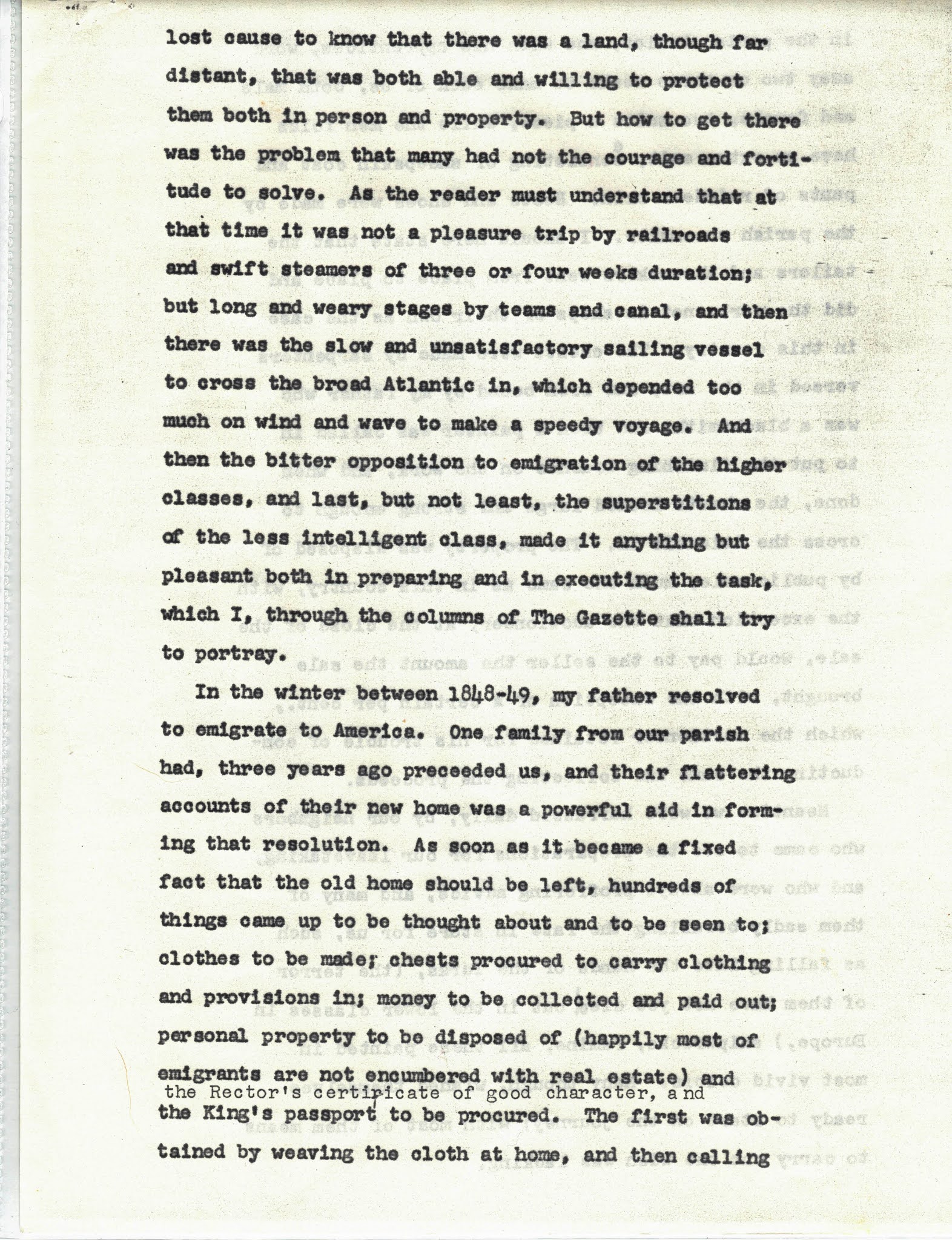
While going through one of my mom’s 3-ring notebooks, I came across a 35-page typewritten narrative written in 1879 and 1880 by another passenger who made the same trip with John and Brita. It’s wonderfully written with details to bring the trip alive for the reader. There is no way that I could summarize this narrative and do it any kind of justice; and so, I’m going to post it in parts that won’t be too long to read at one setting and will keep you intrigued to learn what happened next in their trip.

The narrative was written by Daniel Peterson who was 10 years old at the time of the emigration. He was the son of Anders Peterson and Maria Hansdotter, also of Ulrika Parish in Ostergotland County. While I cannot determine how John’s and Anders’ paths crossed, the farms they were on were in close proximity and they undoubtedly would have attended the same church. Family story tells us that Anders paid for John and his wife to come to America and we learn in the narrative that John worked for Anders, building his home, which lends support to John’s paying off a debt.

Because the narrative was published in a newspaper, I am assuming that my posting it for our family and friends to read would be of no concern.

Enjoy the first installment:


What an incredibly detailed process it was to receive the proper papers to leave Sweden. Being harassed by neighbors and friends, hearing tales of how doomed their lives would be if they crossed the ocean, and the expense of all of this...It's difficult to imagine our ancestors going through all of this to make their way to the new world. And there's more for them to face:


The work that had to be done, the harassment and warnings they received, clearly show in Daniel Peterson's writing. And remember that John Olausson Linn and his wife Brita Eriksdotter were going through the very same formalities and warnings. Next week we will learn about how they traveled to the port where they would sail for America. Just the beginning of an amazing trip to Iowa. And whether you are related directly to John Linn or not, this same process was waiting for the Olofsons and Rasks and Lundgrens and more of our ancestors. And given that Peter Linn came a year later and Gus two years later, I think it's reasonable to assume that their adventure was much the same as well.

If you are unable to enlarge the pages for your reading, please let me know. I can send a couple at a time through email. It's worth taking the time to read. A great find hidden in mom's notebooks.


Sunday, May 23, 2021

ADOPTION OF THE HAGERTY BOYS

I wish I knew the entire story. Today I’m sharing what I do know in the hope that one of you may have information that will help me complete the research on this family.

This is an interesting tale of sadness and joy, of love and sacrifice, a few lingering questions, and a portion of the Linn family.

Roy Oscar Hagerty was born on December 14, 1890; brother George Cleveland Hagerty followed on June 10, 1893; and John Henry Hagerty on May 21, 1895. They were born to Harry Hagerty and his wife Josephine Dorothy Wretling Hagerty. Josephine was born Thea Josefina Wretling in Frotuna, Stockholm, Sweden and came to the United States with her family in 1880 when she was just 9 years old. Her family eventually settled in Kansas where she met and married Harry Hagerty, a naturalized citizen from England or Ireland.

Roy, George, and John were all under the age of 10 when, on December 26, 1899, their parents surrendered them to the Christian Children’s Home in Holdrege, Nebraska. This home had opened in 1888 under the care of a pastor in that town. You can read more about the history of this home at the following site:

Christian Children's Home

From the accounts I’ve read, the Christian Children’s Home was clean, orderly, and disciplined, but not cruel or abusive. The three Hagerty boys would have attended school and church activities and had a group of other young children to play with.

Below is the first page of the intake papers for the 3 Hagerty boys in which we see that the parents have been counseled and believe “that it is for the best interest of the children that said adoption be made”.


We don’t know the complete reasons the Hagertys placed their 3 young sons in the Christian Children’s home, or how they came to select a place in the middle of Nebraska when they had been living in Oklahoma. But we can speculate that perhaps their marriage was troubled, it was too difficult to provide for a family of 5, there was abuse, or even that the parents were ill-equipped to be good parents. Whatever the reason, the day after Christmas in 1899, Roy, George and John Hagerty became the wards of the home. And in 1902, the mother Josephine remarries.

It wasn’t long after the boys were placed in the Christian Children’s Home that the eldest, Roy Oscar Hagerty, was adopted. His new family was William Rinquist and his wife, Charlotte Linn Rinquist. Charlotte (Lottie) was the daughter of John and Sarah Linn, thus our Linn connection to this story.

William Rinquist was born in Sweden in 1847 and came to the United States in 1871. Lottie, we know, was born in Iowa to John and Sarah on January 29, 1857. The couple married on July 3, 1884, in Denver, Colorado and moved to Kansas. They had two children, but only one survived.

We see in the 1900 US Federal Census for Diamond Valley, Kansas, William Rinquist, a farmer, his wife Lottie, and their two children Maria Edna Rinquist, born in July of 1890 in Kansas, and adopted son Roy Oscar Rinquist, born in December 1890. He and Maria were the same age. The census also states that Lottie had given birth to two children but one had died. I have no record of that other child.

We also see in the 1900 US Federal Census the listing for the 2 younger brothers, George and John Hagerty, listed as “inmates” at the Christian Children’s Home in Nebraska:


These two Hagerty boys didn’t have much longer to live at the Christian Children’s Home. In 1901, they were adopted by Carl and Betty Hord. In the 1910 US Federal Census, John is 14 and living with his adoptive parents in Plumgrove, Nebraska. George is listed as a 16-year-old hired hand on a farm in Union, Pottawatomie County, Kansas.

The boys’ biological mother, Josephine, remarried in 1902 to William Quilliam who became a captain in the Salvation Army until he was investigated for embezzling money from the organization. It appears that Josephine didn’t have great success with her husbands!

Several interesting facts surround these 3 young men as they grew up. From the article below, you can see that they all had contact with their birth mother. She knew where they were and additional articles show her visits with at least one of her sons.


I’ve tried to find additional info on the biological father, Henry Hagerty, but I’ve been unsuccessful.

John Henry, the youngest, used the last name Hoard/Hord as far as the 1910 census when he was 14 years old living with Carl and Betty Hord, but by the 1920 census, he had returned to using his birth name again, John Henry Hagerty; and he used that last name the rest of his life.

When William Rinquist died in Fresno, California in 1912, his will stipulated that his adopted son Roy Oscar would receive $50; his biological daughter Mary received $3,000.


Were there difficulties in the homes where these young men were raised? At the time, would there normally be a difference of money given either to men and women in a will or to an adopted child? I have no way of knowing as only facts are generally available to the family historian. But it does make me curious about the warmth and contact the 3 had with their birth mother, Josephine, the use of the original last name by one of the boys, and Roy Oscar Rinquist remaining in Kansas while the rest of his family moved to Fresno, perhaps leading to a breakdown in that family and a nominal inheritance.

Our Linn relative, Roy Oscar Hagerty Rinquist, served in World War I, enlisting on December 14, 1917, and discharged on October 3, 1919. Before entering service, he was a streetcar conductor in Kansas City. He was in the Aviation Corps, served in France and, on October 5, 1918, Roy was admitted to the hospital in Lorient, France, for a short stay and was dismissed on October 28 and sent to USN Base #19.

When he returned to the United States, Roy married in 1919 to Olivia Nordenberg and continued his work as a conductor. In 1927, the couple made an ocean trip back to Sweden, coming back through New York on September 5 of that year.

Sometime after the 1940 US Federal Census, the couple moved to Miami, Florida, where Olivia died in 1969. Roy remarried in 1971 to Hilda Nelson; and he died in April 1974. Roy had no children with either woman.

Roy and his brothers are not close relatives, second cousins twice removed. But their story is interesting to me; and at this point in my research, I’m much more interested in the life stories than in collecting more and more names and dates. These stories, I hope, show the humanity, the problems and joys, the lives of those who came before us.