I've enjoyed Daniel Peterson's writing. It certainly is the closest account that we will have about those early days in Iowa and how our ancestors survived and thrived. This account will describe how corn was ground, deer and elk were hunted, what the early settlers did for amusement, and the difficulties of building just a simple house on the prairie.
Thursday, November 4, 2021
Iowa Early Days - Part 2
Saturday, October 30, 2021
Question About the Early Iowa Days
A few days ago I posted the first of two parts that give us a look at how our ancestors lived in the early 1850's in Iowa. Daniel Peterson certainly had a way with words, adding details and the flowery language of the day.
I'm so glad to know that several of you are enjoying his writings and remembrances and have contacted me. I received an important question this week that I'd like to answer for everyone.
Since John Linn and his wife Brita came with a group that included Andrew Peterson and his family, why in the first part of this post did Andrew need to travel north 25 miles to see his old friend John Linn?
It's true that Andrew Peterson and John Linn traveled together from Sweden to Iowa. I have ship records and moving out records and, of course, Daniel Peterson's story to verify this. Normally, immigrants settled close to one another. They needed each other to help build their homes, to translate for others and conduct business, for safety, to worship, and more.
It's clear from Daniel's writing that John Linn traveled farther north to settle and that Andrew Peterson brought his family up two years later. I have no answer for why. Did John strike out on his own? Did the group split into two or more smaller groups to settle? Did Andrew need to stay behind because of any health issues or to greet other new immigrants?
Twenty-five miles today seems like nothing and, indeed, these two families did live in the same county. But this two-day trek for the Petersons might have meant that the Petersons longed for more Swedish community around them or more help on a regular basis.
When I received this question, I re-read the first portion of Daniel's writing to see if a reason was given, but I found nothing. Next, I went to the 1850 US Federal State Censuses. And there I do find John and Mary Lynn (sic) living in Boone County in dwelling 830, and family 858. I'm sure that the reason the dwelling numbers and family numbers don't match is that a dwelling might hold several families in this new state.
I also found Andrew Peterson's family living in Boone County, but in dwelling 760, family 786.
How far apart these two families were is unknown as I cannot locate any document that tells HOW, or IN WHAT ORDER, the census was taken. The two pages of the census were taken 5 days apart. Both were taken by Assistant Marshal, Peter Myers. None of this helps determine the WHY for the initial settling of John Linn and Andrew Peterson, but I hope it helps a bit.
One thing I've learned about genealogy is that every answer leads to more questions!!
You also would have read that Andrew Peterson purchased the claim of Pleasant Chitwood and may have wondered about this name. Mr. Chitwood was born in Tennessee and came to Iowa sometime in the 1840's. In 1848, he took a claim in Pilot Mound Township in Boone County and hired a man named Thomas Sparks to clear the prairie land. In taking his family across the river to this land, both he and his wife nearly drowned. It's this land that I believe Andrew Peterson purchased. Chitwood later was the sheriff of Boone County. (History of Boone County, Iowa, Vol. 1, Nathan Edward Goldthwait, p. 276-277)
In a few days, I'll post the rest of Daniel's remembrances of early life in Iowa.
Monday, October 25, 2021
LIFE IN THE EARLY DAYS IN IOWA
Several of you have asked me to write about what our ancestors encountered in their early days in Iowa. What was their daily life like? How did they survive the extreme weather? Did they build churches and schools? What hardships did they face?
I've searched for information that I thought would be relevant to our Linn, Olofson, Barquist, Carlson ancestors; but it appears that none of our ancestors wrote much of anything to pass down. We were fortunate to have the story written by Daniel Peterson about the journey from Sweden to Iowa in 1849-50. And as I continued through my mother's notebooks, I came across more of Daniel's writing. This time, at the age of 39, he wrote his recollections of those early days in Boone County. His story is full of details that helps us understand the courage and strength of our early ancestors. Our Linn ancestors are mentioned throughout this piece. And, because of his writing, we can also learn what our other ancestors would have faced as they settled in Iowa nearly two centuries ago.
Like Daniel Peterson's other writing, this one is also long--10 page long. But I want to share it with you as he wrote it. I hope that you enjoy this look at life in early Iowa. We start with the Peterson family deciding to travel a bit north of Raccoon Forks to Boone County where they receive help from John Linn.
NOTE: In this first post, a mention is made of the Dragoon Trail. For those of you who don't know about this well-marked section of Iowa, I've copied from wikipedia a brief description:
In 1933, the State of Iowa opened the Dragoon Trail, a scenic and historic drive along the Des Moines River.
The trail follows the path of the 1st U. S. Dragoons, the country's first mounted infantry unit, on their historic march in the summer of 1835, to scout Iowa after the Black Hawk Purchase of 1832 put the area under U.S. control. The march lead to the establishment of outposts from present-day Fort Dodge and Webster City through Des Moines to Pella and Knoxville.
The Trail is about 200 miles long and passes cultural, historical, natural and scenic attractions including Lake Red Rock, Ledges State Park, the Kate Shelley High Bridge and Dolliver Memorial Park.
It starts with two branches originating from Fort Dodge and Webster City that join near Stratford; from there it runs through Boone and Des Moines to the Red Rock Dam between Pella and Knoxville.
Don't you enjoy hearing about the excitement for the mail, especially the Harper's Magazine? And the dislike of a daily staple, corn bread, after having it at every meal? We also see that Gus Linn's family had arrived and established himself in the community as well.
Tuesday, October 19, 2021
Gus and John's Excellent Adventure Photo
On 26 August, 2018, I posted a story about John and Gus's trip back to Sweden in 1894. This was their final opportunity to see their homeland and family and friends, for Gus passed away in 1897 and John in 1907.
I recently came across a photo taken in Sweden of the brothers and some of their relatives.
Sunday, October 10, 2021
FROM GOTHENBURG, SWEDEN TO BOONE COUNTY, IOWA
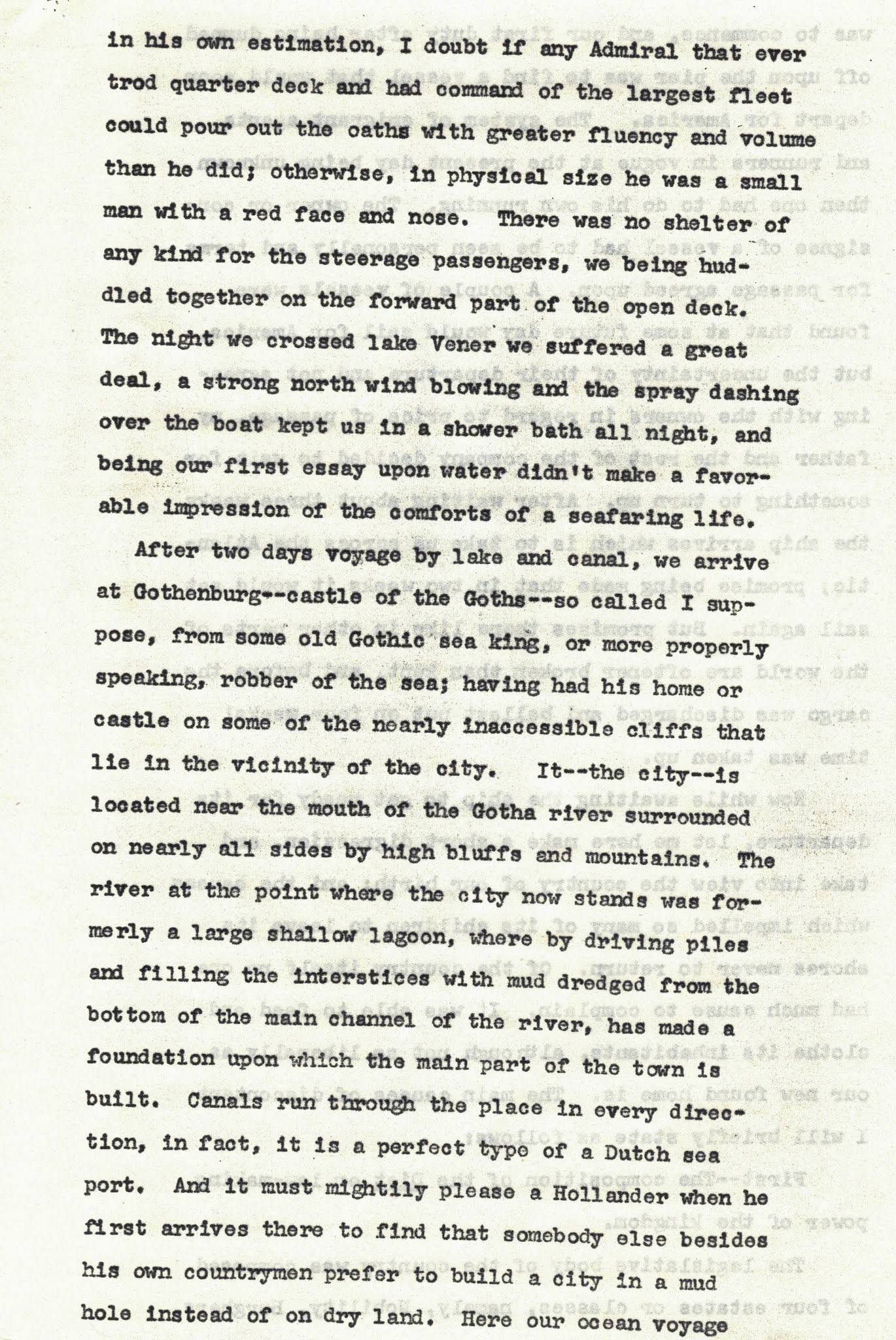
We've read about the difficulties that John Linn and his wife Brita Eriksdotter had in 1849 gaining permission to leave, making the trip to the port, and waiting for their turn to finally board the ship to North America. Today is Daniel Peterson's final pages that, I think, are the most compelling. We learn about the actual trip across the ocean and then all of the twists and turns, diseases and deaths, to finally make it to their destination.
This is a very detailed description of what Daniel saw and experienced and for that I'm so thankful. But as we continue to follow this group from the shore to their destination, it can be difficult to follow. At the end of this narrative, I've placed a map showing the route they took to make it a bit easier to see.
Library of Congress maps: https://www.loc.gov/resource/g3700.fi000230/ for the 1850 map which I used to create the following:
- Sandy Hook, a barrier spit in Monmouth County, NJ; Health officer came on board. Towed up to Castle Gardens which was simply a port until 1855 when it was established to help with translations, letter writing, quarantines and more;
- Steamer up the Hudson River to Albany, NY
- Canal boat through the Erie Canal to Buffalo, NY
- Lake Steamer bound for Chicago which took 5 days; Notice the long way around through the lakes because no railroads were there at the time for a more direct route
- Boat on the Michigan and Illinois River canal to Peru, IL.
- Steamship to St. Louis where they experienced severe cholera.
- Boat captain took them up the Mississippi River to Keokuk, Iowa
- Teams and teamsters took them to Des Moines (Raccoon Forks) by canoe.
- Teamsters took them by land to Boone County.
Thursday, October 7, 2021
ANSWERING A COUPLE OF QUESTIONS
Monday, October 4, 2021
PART TWO IN JOHN LINN’S MIGRATION
I hope you enjoyed reading the first part of the migration to the United States of 37 Swedes, including the Peterson family, along with John Linn and Brita Eriksdotter. The difficulties they had in obtaining the necessary approvals, the warnings and threats they received from family and friends, and the sad goodbyes to those they loved and to their home country, had to be difficult for every one of our ancestors.
In this installment written by Daniel Peterson several years after the migration, we learn about how these Swedes made their way to Motala, a destination where they would wait for transportation over the series of canals and rivers that would take them to the port of Gothenburg where they hoped to find a boat that would take them across the ocean.
This installment will take our group to the port of Gothenburg where the writer describes the various reasons why the Swedes were eager to leave for a new country.
John and Brita were the first two on the Linn ancestral line to migrate. But those of us who also are related to the Olofson line know that the Olofsons came in 1850 from northern Sweden to Wisconsin, probably following some of the same routes.
Enjoy reading Part 2. And please send any questions or comments to me through the blog: ancestorfootprints.blogspot.com