My ancestors came from both Sweden and Bohemia, settling in Iowa. Through this blog I hope to share information with my own relatives about my Swedish ancestors. Please comment or share any interesting and relevant information you have on this family line.
Showing posts with label Olof Rask. Show all posts

Sunday, June 17, 2018

Father's Day

Today I honor the Swedish dads, those men who paved the way for those of us who follow them through their strength and leadership, their bravery and hard work.

To my grandfather: Peter Edward Linn (1892-1980); and his brother, Frank Frederick Linn (1895-1986);

To my great-grandfathers: Andrew Frederick Linn (1861-1939) and William Edward Olofson (1866-1924);

To my great-great grandfathers: Gustus Magnus Olausson Linn (1829-1897), Carl Magnus Andersson (1828-1896), Olof Olofson (1837-1924), and Olof Rask (1824-1888).

And so many, many other men that I research and write about, I thank you on Father's Day. Their lives, no matter how insignificant or humble they may have seemed, are appreciated today. Just four generations back, our family was toiling in Sweden. Our ancestors were poor. They had no opportunity to own land, to provide for themselves or their families.

We have no royalty or wealth in our family history. But the opportunities these men and their families gave us to seek our own paths, to find our own happiness, is immeasurable. I feel a connection to these men, and that's why I document their lives and pause today to thank them.


NOTE: Did you notice on the dates above that William Edward Olofson and his father Olof Olofson died in the same year? William died on February 12, 1924 (age 57); his father died on July 16, 1924 (age 86).


Peter Edward Linn


And to all of my family members who are fathers, happy Father's Day to you!

Sunday, June 3, 2018

More About Sophia Margrite Kjellander

My great-great grandmother, Sophia, had started her life in Stockholm with two loving parents and three sisters, a normal, happy life. But by the time she was 8 years old, both parents and one sister had died. She was separated from her other two sisters and sent to northern Sweden to live with strangers. As she started her adult life, she moved often and at one point was "a person without a permanent residence."

Sophia's first daughter, Anna Margretha Jacobsdotteer, born on December 23, 1845 in Stugu By, Stugun Parish in Jamtland County, was listed as oakta (illegitimate) in the birth record. Another illegitimate daughter, Carolina Josephina Carlsdotter, was born on July 1, 1848; and a third illegitimate daughter, Stina Sophia (no last name listed) was born on February 20, 1852, in Stromsnas, Stugun Parish.

On April 27, 1852, Sophia's first-born child, Anna Margretha Jacobsdotter, died and was buried on May 24. Sophia had moved several times in 6 years, had given birth to 3 daughters by 3 different men, was listed as a person without a permanent residence, and now had lost her six-year old daughter. Her life just seems so sad, filled with instability.

At some point after the death of her daughter, Sophia met Olof Rask in Stugun Parish, and he became part of the picture with Sophia and her daughters. In the 1853-1861 clerical survey for Stugun Parish, Sophia is listed with five illegitimate children: Carolina Josephina Carlsdotter, Stina Sophia, Anna Christina Rask (born October 24, 1855), Berta Margreta Rask (born December 24, 1857), and Olivia Rask (born November 18, 1859). Sophia and her five "illegitimate" children are listed with the heading "people without a permanent residence".  The three younger children all have the last name "Rask" indicating that Olof Rask fathered these three girls. On that same page, Sophia and her daughters are listed again with Olof Rask after the marriage of Olof and Sophia on February 23, 1861. A note next to Sophia's information in which she was introduced back into the church says in part "The laborer Olof Rask acknowledges her as his wife to be."

Being introduced back to the church could mean that the parishioner would stand up in front of the priest and congregation, confess to her sins and then be forgiven. Another explanation for being reintroduced into the church was that women in Sweden at that time who had given birth were thought to be "unclean" until six weeks after the birth of their child. Being introduced indicated that this six-week period had ended. Because Sophia had given birth in late October 1855 to Anna Christina, her reintroduction on December 2 coincides with this six-week period.

Olof Rask didn't seem to be a great catch. He was born on March 16, 1824, in Heden in Bollans Gavleborg, the 4th of 8 children of Olof Rask and Stina Lindberg. Olof came from a long line of military men, but Olof himself had lived a nomadic life, moving around several times and, at one point, was listed as defenseless but honest and of good character. Olof was missing papers proving his movements from March 10, 1845 to January 1851, a serious offense at that time.

Why did this couple move so often? Was Olof trying to find work? Was he running from something in his past since he didn't have the proper papers to move? Was there a stigma to the number of children Sophia had out of wedlock? I have had to meticulously track Olof and Sophia individually and together as they moved so often it would have been easy to have lost them in the clerical surveys.

Sophia seems to have finally found the relationship and family that she wanted. To recap the children Sophia had, both illegitimate and while married to Olof:

  • Anna Margretha Jacobssdotter, born December 23, 1845; died April 27, 1852;
  • Carolina Josephina Carlsdotter, born July 1, 1848;
  • Stina Sophia (no last name listed), born February 20, 1852
The last five children were fathered by Olof Rask:
  • Anna Christina Rask, born October 24, 1855; died July 8, 1878;
  • Berta (Brita) Margreta Rask, born December 24, 1857; died April 6, 1930 in Iowa;
  • Olivia Rask, born November 18, 1859; died March 18, 1943 in Iowa;
  • Johanna Maria Rask, born October 12, 1861; I believe she also came to the US;
  • Karl Olof Rask, born April 25, 1864; died on July 30, 1930 in Chaseley, North Dakota.

Olof Rask and Sophia Margrite Kjellander, around 1880

Sophia died of cancer on July 5, 1888, in Bollnas, Gavleborg, at age 66 years, 2 months, 26 days. Olof died six months prior to Sophia's death in Bollnas on January 7, 1888. The cause of death was undetermined. He was 63 years, 9 months, 21 days old.

Sophia's life began quite normally with an intact family consisting of her parents, Carl and Margaretha, and her three sisters. But a series of tragedies and sad events sent Sophia's life in a different direction. Because of these events, it could have been easy to dismiss her life and to dwell on her misfortunes. But, Sophia was a survivor. And, in the end, Sophia found love, had a family, and was able to overcome the twists and turns life threw her way.

*Sophia was Grandma Linn's (Maude Edith Olofson) maternal grandmother. This photo of her grandparents was hers. I imagine that Olivia and Brita brought the photo with them when they came to the US. And I wonder now what Grandma knew of her own grandmother's story.

Sunday, April 15, 2018

A Swedish Soldier


Last fall I decided to put together what I know about my military ancestors, those who served in the Czech Republic, Sweden, and the United States. There were over 25 of them, serving their country during times of war and peace. Periodically, I will include one of our Swedish soldiers in my blog.

In Sweden, after 1692, the soldier allotment system worked this way: A number of farms made up a rote, and each rote was responsible for one soldier. The farms had to recruit the soldier, give him and his family a cottage and piece of land, and pay a salary. During peace time, the soldier would do military exercises with his regiment and be called upon to provide other duties. In times of war, his family and farm were taken care of while he was gone. If the soldier died, the soldier’s family had to move to make room for the next soldier. And when the soldier retired, he and his family immediately left the farm.

One of my Swedish military ancestors was my 4th great grandfather, Martin Hedberg. He was the great-grandfather to Olivia and Brita Rask (Olofson). Martin was born to the soldier Olof Boman and his wife, Anna Martensdotter on February 4, 1745, in Bollnas Parish in Gavleborg County.

Having researched my family history for over 40 years, I know that not every person lives up to the ideals we might hope for or live the kind of life we might imagine. Often, their lives have both positive and negative parts to them, the ups and downs of life. Martin was one of those ancestors.

Without a full history, complete explanations and details, it's difficult to know when the few facts available lead to an accurate assessment of a person. I don’t have exact dates when Martin served as a soldier. It’s my guess that he was discharged or retired by the 1783-1786 clerical survey when we see Martin moving several times, from farm to farm, within Bollnas Parish. He did not have papers that allowed him to move, was not able to pass the yearly clerical examination given by the parish priest, could not read, did not know the Bible or was able to recite anything he was asked. Because of these shortcomings, Martin Hedberg was sent to work at a fortress in 1786, probably Fredriksskans in Gavle to work at hard labor. It would have been similar to a prison.


Fredriksskans Fortress


Fredriksskans fortress was erected on a small island on a fjord and was originally used as a fort for protection of the area, but later became a prison. Martin was there from 1786 but would have been out by 1789 as he fathered a child then.

By 1798, Martin was living with Ella Palsdotter and their illegitimate children. Anna (born 1789) and Olof (born 1792). Martin is noted as being a discharged soldier in the clerical survey. To date, I've never found a marriage record for Martin and Ella, and their children were always listed as oƤkta or illegitimate.

Martin’s death record states that he was a retired guard, receiving a pension from the military. He died on April 30, 1807, at the age of 62.

It's important to note that, in Sweden, under the Lutheran Church, the yearly clerical surveys conducted by the parish priest were taken very seriously. These examinations helped the Lutheran State Church in its responsibility to keep track of its people. They also served as an opportunity to teach church doctrine, reinforce disciplinary authority (thus the punishment for Martin Hedberg), and promote a healthy society through the recording of vaccinations. Anyone who could not meet basic church requirements would have been penalized in some way.

While it's clear that Martin Hedberg honorably served his parish or rote as a soldier, he was unable to maintain a lifestyle that satisfied the state church. Perhaps he was simply poor which led him to move around and to not learn to read or study the Bible; perhaps he was defiant of the church doctrine and rules. I have no answers to the "why's" of Martin's life and the decisions he made. But we are descended from his son Olof, grandson Olof Rask, great-granddaughter Olivia Rask, and great-great granddaughter Maude Edith Olofson. For that I'm thankful.

Sunday, March 18, 2018

Two Sisters - Part Two


Olivia Rask Olofson was my great grandmother. But as we saw in last week’s posting, she was also my second great aunt. Olivia and her older sister Brita’s parents, Olof Rask, a wonderer and laborer, and Sophia Margrite Kjellander, an orphan, peasant girl and unwed mother, had individually led difficult lives. But when they found each other, they seemed to find happiness. Olof Rask and Sophia Kjellander married on February 23, 1861, in Jamtland County, Sweden. Sophia had given birth to 3 children prior to meeting Olof, but together they had the following children:

·         Anna Stina Rask (1855-1878)
·         Brita Margrite Rask (1857-1930)
·         Olivia Rask (1859-1943)
·         Johanna Maria Rask (1861-?)
·         Karl Olof Rask (1864-1930)

Olivia’s birth year has been in dispute, with incorrect information being circulated both among family members and on on-line trees. Most early records, and her cemetery stone have the wrong year:

Olivia was not born in 1862, and my opinion is that she wanted to shave a few years off of her age. Olivia was born on November 18, 1859. Because she came to the United States as an adult in 1881, clearly Olivia knew when she was born. In Sweden it was on all church records that she was born on November 18, 1859. Perhaps taking a few years off her age made Olivia feel as if she could attract a suitable spouse once she came to the United States. And William Edward Olofson, our great-grandfather, born in 1866, was available.

As just one example of the correct birth year for Olivia, the following church survey from 1853-1861 for Stugun Parish in Jamtland County shows the mother Sophia Margarite Kjellander with 5 of her children, with Olivia’s birth date shown as November 18, 1859. Olof Rask is at the bottom of this screen. All of them are counted in the survey as being “people without a permanent residence” meaning they were probably homeless.


I'm fortunate to have inherited the Olofson family bible that is in Swedish in which births, marriages, and deaths were recorded. You can see below that Olivia's birth year of 1859 was crossed out and 1862 written in.


And, here is Olivia's birth record. Maybe not easy to read the Swedish, but you can see the underlined names Olivia, daughter of Olof Rask and Sophia Margrite Kjellander born on November 18, 1859. Confusion resolved!


William Edward Olofson and Olivia Rask married on October 17, 1889, and had the following children, two of whom did not live past infancy:

·         Lee Verne (Vernie) Olofson (November 22, 1890 – September 2, 1959)
·         Lily Sophy Olofson (May 3, 1892 – December 14, 1979)
·         Agnes Olofson (December 16, 1894 – December 19, 1894)
·         Maude Edith Olofson (March 1, 1897 – March 30, 1973)
·         Edward Olof Olofson (October 12, 1899 – February 27, 1900)

The stories about Olivia are ones that show her as a difficult person. But as she aged and spent time as a widow living both on her own and later with her children, perhaps some anger, frustration and even paranoia make some sense. Here are just a few stories given to me by family members:

Wedding Picture of William and Olivia Olofson
A story from both LaVonne Pliner Linn Halligan and Veryl Olofson was that Olivia, in her later years, believed someone was trying to "gas her". So, she put rags under the door to keep the "gas" out.

In a letter from Veryl Olofson (postmarked 21 Feb 2012), "the Olofsons home place was 1 mile south and 3/4 mile west of town. The folks moved there in 1924. So, I assume this is when Grandma Olivia moved into town. She lived in the south part, "Rosstown" as it was called. A small 1 1/2 story house. Dad would wait in town for me to come from school. Then we would stop by to see and visit with her. She always had a cup of coffee for dad and a cookie for me. This was 1932-36. She only talked Swedish, so I listened and picked up some of it. Enough that I got my job in town at the hardware store because I could serve the Swedish customers. Grandma was having a problem, mostly at night, as she thought people were "milling around" her home. She would have dad go outside and check all around. no sign of anything. He talked with her neighbors and they didn't know of any trouble. Dad discussed this many times with his sisters, as it became more frequent, about 1935 they decided that they would take turns keeping her in their homes. Dad sold her house in 1936 for $600, no state, Fed aid or nursing home existed then. Her mental and physical condition continued to deteriorate. I never ever saw her do anything other than eat and talk with dad. She spent about 10% of her time with Maude, 15% with dad, and 75% with aunt Lilly Lundgren. The last year or so, 100% with Lilly. She passed away in March of 1943. I was 16 years old, Ellis just turned 15, Ivan 11, and Merlyn 6 years old. We only knew of her being sick. She died of stomach cancer. Always a small lady who decreased in size as she got older. Must be heredity as my dad did also."

And, in an email from Ellis Linn to Myron Linn dated 9 December 2009: "My mother's mother (Grandma Olivia) was very strong in her thoughts and actions. When mealtime came around she would help or attempt to help my mother getting all of us to the table. When she said 'sit down' you had better sit down or she would HELP you. She used to babysit me when I was 5 or 6 years old. She would tuck me in bed and then proceeded to read me a bedtime story. Only a few sentences were spoken in very poor English and then Grandma switched to the Svenska (Swede) dialect. I couldn't understand what she was saying but at the end of the story I would always tell her 'that was a good story', thank her, and then go to sleep."

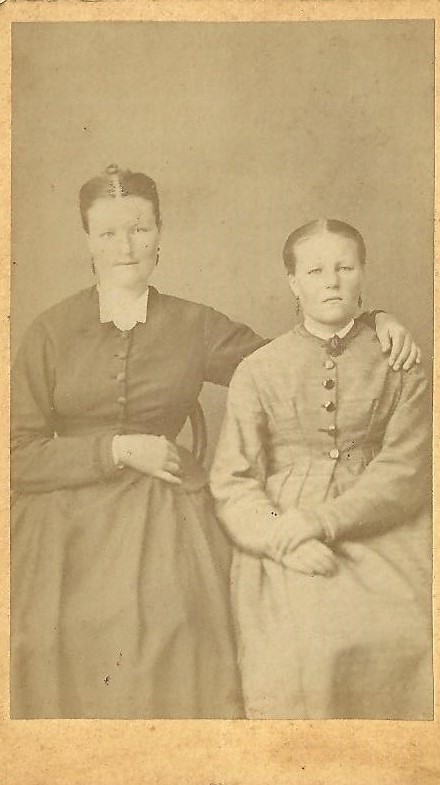
Brita and Olivia Rask
And one family member recalled her chasing him around the table with a knife threatening to cut his tongue out for being cheeky.

William Edward Olofson died at age 57 on February 12, 1924. Olivia did live for a time in town by herself until her health deteriorated.

In the 1930 US Federal Census for Stratford, Olivia is seen living on her own at 196 Teneyck Street. The value of her home was $2500.

Later, she lived with her children, with Lily at the time of her death on March 18, 1943. William, Olivia, and their two infant children Agnes and Edward are buried at the Hardin Township Cemetery.


Lee Verne, Maude, and Lily