My ancestors came from both Sweden and Bohemia, settling in Iowa. Through this blog I hope to share information with my own relatives about my Swedish ancestors. Please comment or share any interesting and relevant information you have on this family line.
Showing posts with label Maude Edith Olofson. Show all posts

Wednesday, July 12, 2023

How Did I Get to be Finnish?

Have you taken a DNA test yet? I've tested through two companies: Family Tree Maker for my female ancestors through my mother, and Ancestry for a look at both sides of my gene pool. As you might guess, I'm 45 percent Swedish from both Northern Sweden (my Swedish grandmother's side) and Southern Sweden (my Swedish grandfather's side). A like amount is from my mother's side: Czech, Germanic, and Eastern European. But I do have 5 percent of my genes from Finland and it is attributed to my Swedish ancestors. So how did that happen?

Both of my brothers tested, and they both have 8 percent Finnish ancestry. One of my Swedish first cousins, once removed tested, and his results show 9 percent Finnish. I was fortunate to have one of my paternal uncles test a few years back, and he tests at 20 percent Finnish.

As I always mention when writing about DNA, I am not an expert in DNA research. I'm barely a novice who has attended a few workshops to gain a basic understanding of my DNA to use in my own research.

First, is there a way to understand how far back my lineage might go to gain 5 percent from a Finnish ancestor? There are actually many combinations that could account for that 5 percent.

As you can see above, my brothers and I don't share the same percentage of Finnish ancestry. Likewise, we don't share the same percentage from each of our parents. One of us is more Swedish than the other two. DNA is passed down randomly. So, while one parent may have 10 percent Italian for example, none of that 10 percent might have been passed down randomly to the child.

When I look at my mom's DNA, she has NO Finnish ancestry. Thus, it's a certainty that my Finnish DNA, as well as my brothers' Finnish DNA, came from our paternal line. My Swedish uncle (my father's brother) has 20 percent Finnish DNA, just a bit more than twice what both of my brothers have at 8 percent. Because that uncle is one generation closer to the Finn ancestry, his 20 percent makes sense. And, because my first cousin, once removed has 9 percent Finnish DNA and is related to my paternal grandmother, it seems clear that the Finnish DNA comes through Maude Edith Olofson Linn whose ancestors are from the north-central portion of Sweden.

The Finnish DNA is not from the Linns; it is from the Olofsons. 

Next, can we narrow this down a bit more. 

Until 1809, Finland was a part of the Swedish empire, under Swedish rule. 


During the 1600's, in the areas where Maude Edith Olofson Linn's ancestors were from, iron ore had been discovered in the forested areas. While the Swedes were capable of mining the ore, they did not have the ability to refine it. Thus, the Finns were invited to come to the forest areas in the 1600s. These areas were now used to make charcoal for the iron blast furnaces and iron works and to refine the ore for military use.

Can we find any Finns in Maude's line who might have been iron workers? The answer is YES. My 7th great grandfather, Bertil Monsieur, was born in Finland in 1644 and died in Hanebo Parish, Gavleborg County, on 8 April 1739.

But how much DNA could I possibly have inherited from a 7th great-grandfather? Pretty much nothing. Less than 1 percent. Of course, other factors play a roll. DNA inheritance is random. What if I inherited 3 percent or even 4 percent from Bertil Monsieur? What if his son, my 6th great grandfather, inherited a larger amount, up to 50 percent Finn from his father, or if he married a full-blooded Finn, passing on 50 percent or MORE between the two of them to their children? What if other ancestors of Maude's had small amounts of Finnish DNA that randomly mixed and found their way to my generation?

And, what if there was general mixing of DNA during that time between Swedes and Finns, proximate neighbors where genetic differences are very small, even before Sweden captured Finland and ruled?


In general, 4-5 generations back is where we can stop counting DNA as a good indicator of our heritage. But it's not a hard rule. Randomness. That's what makes each of us different from our siblings, our cousins, other relatives. While I've been told that I look like Maude, my paternal grandmother, I actually have a bit more of my mom's DNA in me. Maybe the Bohemian/German DNA is more about my height, my nose, my cow ankles or the random curls in my hair, but my Swedish DNA is more about my facial features and blue eyes. 

I would never tell anyone that I am part Finn. The amount is so small, the randomness makes it impossible to narrow down completely, and all people from Nordic countries do share some of the same genes. I would tell people the story about Bertil Monsieur and other people from Finland being invited to help with the iron ore refinement and that he is my 7th great-grandfather because I know that to be 100% true. But whether Bertil was 100% Finn, or was simply born there and was really some other ethnicity, is something I will never know with certainty.

Another reason I just love genealogy!!!

Sunday, June 12, 2022

Maude Edith Olofson Linn Brush With Death

Do you ever wonder what our family would have looked like if Gus Linn hadn't made it back from the Civil War? If John Linn's first wife hadn't died in childbirth? If Olof Olofson and Maria Barquist had never met? If any of our ancestors hadn't left Sweden for the United States?

Today, I'm sharing an article recently found about my grandmother's brush with death.


While I don't have a date on this article, we can assume that it happened well before she and Peter Linn married in 1920. I'm thankful for her brother Vernie's quick action in finding her and bringing her home, badly bruised, injured collar bone, unconscious and in a weakened state, but alive. 

Married to Peter Linn in 1920, Maude gave birth to 5 sons, who in turn produced over 20 grandchildren, and many great- and great-great grandchildren today. 

Our ancestors survived many accidents, illnesses, wars, the 1918 flu, and more. I'm always mindful of the hardships they endured and the strength and courage they had. But today, I'm especially thankful that Grandma Linn survived a horrible accident and lived a full life with a large family who loved her and remember her.


Sunday, April 17, 2022

More Nobility Found

Having farmers and laborers for ancestors gives me great pride. Hard-working people who sacrificed a great deal, braved elements, served their country, attended church, and were overall good and generous people.

It is only when I come in contact with other family historians and genealogists when the discussion turns to the famous, the infamous, the rich, the scoundrels that I have to admit that I have none. I’ve been told that “you just haven’t found them yet,” which is difficult to hear as I’ve been working diligently on family history for over 40 years. Slow. Deliberate. As accurate as I can be.

If you’ve been reading this blog, you learned about my “find” on the Linn side of our family when Amund Persson married Catharina Margaretha Strahle. She died in childbirth and I thought that was the end of that. But I learned recently and wrote on March 29, 2021, that Amund and Catharina had another son, born 2 years earlier, who survived, making us related to all of the well-connected, titled people who were ancestors of Catharina.

Could there be more? For those of you who enjoy joining the conversation about the famous or well-connected ancestors, and are descended from the Olofsons and Rasks, I can now report that you had some very important people in your line. But as usual, there’s a twist.

Let’s start with a look at the ancestors involved in this line:

Anton Christiani von Sternfeldt married Katarina Elisabeth von Ceurmen

     Johan Conrad von Sternfelt with Brita Nilsdotter, later married to Catharina von Scheffer

          Johan Johansson Starnfelt married to Marget Jonsdotter

               Lena Starenfelt never married

                    Stina Lindberg married to Olof Rask

                         Olof Rask (their son) married Sophia Margarite Kjellander

                              Olivia Rask married William Edward Olofson

William and Olivia Olofson had 3 children:  Lee Verne (Vernie) Olofson, Lilly Olofson, and Maude Olofson. It is Olivia Rask’s ancestors who give us the famous ancestors. Surprised? Given what we know about Olivia’s parents, Olof Rask and Sophia Margarite Kjellander, I’m stunned. This family was poor. Olof’s parents were poor. Olof’s grandmother, a single mother, died in the poor house. So how do we go from nobility to having an ancestor die in the poorhouse? It took just 3 generations to go from one end of the socio-economic spectrum to the other.

Anton Christiani von Sternfeldt and his wife were both born in Latvia in the mid 1600's. Latvia, at that time, was a part of the vast Swedish empire.


You can see above that Riga, in Latvia or Livania/Livland as it was known then, was a part of the Swedish empire. Our having ancestors born in that area doesn't seem to change any of our DNA, at least not in that of family members I have access to. 

Livland was a part of Latvia at the time of Johan's birth. It was taken by Sweden and later by Russia:
Sweden retained these territories for almost a century, defending them from both Poland (Polish-Swedish War, 1654-60) and Russia (Russo-Swedish War, 1654-61). In 1721, however, after the Great Northern War, Sweden ceded them to Russia (Treaty of Nystad)

This area also bordered German and, as you might guess, language, culture, and titles were similar then. The title "von" was often used to show a noble status originally designed to show land holdings. The family surname was the land you held. Thus von Ceurmen was "from Ceurmen". "Von" is a low-tier nobility title, but nevertheless, showed a level of wealth and land, and perhaps other rights and privileges in society.

Anton Christiani Sternfeldt and Katarina Elisabeth von Ceurmen's son Johan was born in Riga in 1684. As an adult, Johan Conrad von Sternfelt was a captain and an artillery man, commissioned in Sweden, primarily in the Stockholm and Jamtland counties.

From various Swedish books and articles that I've slowly done my best to translate, Johan Conrad met a married woman, Brita Nilsdotter, and conceived a child out of wedlock. Their son Johan Johansson Starnfelt was born in 1731 in Rodon, Jamtland Sweden. 

When Johan's father, Johan Conrad von Sternfelt was 48 years old, he then married a titled woman, Catharina von Scheffer. It appears that they had no children. There are also accounts showing that Johan Conrad von Sternfelt and his wife Catharina von Scheffer provided for Johan's son and for Brita Nilsdotter. 

But as you can see, the title was not passed on to the illegitimate son, Johan Johansson Starnfelt. This is where the breakdown in nobility status happened. Johan Conrad had to go before the church and confess his sin and take responsibility. Johan Conrad von Sternfelt also was involved in a criminal case and accused of murder in the spring of 1732. He was transported to Stockholm where he was acquitted.

Johan Conrad von Sternfelt sounds like quite an ancestor. Titled but wild. Involved in criminal cases including a murder. But his illegitimate son Johan seemed to be a different man. Johan was a ferryman (farjeman), a hard-working man with no land; he married Marget Jonsdotter, and together they had 5 children, the youngest being my 4th great-grandmother Lena Starenfelt. The family of 7 seems to move residences from one side of a river to another in the Rodon area as the ferry work might have demanded.

Lena, or Helena Starenfelt was born in 1767 in Jamtland, never married but had one daughter, Stina (Christina) Lindberg. It's not clear where the last name was from, perhaps the farm she lived on or even from her father. Lena was sent to the Poor Farm in Heden in 1843 and died there in 1847.

Stina, my 3rd great grandmother, was born in 1795 and married a "defenseless, but honest and of good chararcter" Olof Rask in 1814 in Heden.

So, are we nobility? I would say so. Land owners, captains, artillery men, ancestors with prestige in the community. But how quickly this all changed when the illegitimate son was not given the title or access to any of the land or prestige of his father. 

I've found two books thus far written exclusively about the Starenfeldt's. One in Swedish. The other in German. I'm hoping to have some of these translated to gain a deeper understanding of their achievements and lives.


It's another fascinating story in our family history. Instead of rags to riches, it's riches to rags. 


Tuesday, September 28, 2021

OLOFSON PHOTOS

 I have so many photos of the Olofson family. From my great-great grandfather Olof and his second wife and family to William Olofson, his wife Olivia, and their children, and more. Today, I'll pick a few that I'm not sure I've shared before. I hope there are some new ones in here for you to enjoy.

Olof Olofson married Brita Rask in 1880 and together they raised William who was the son of Olof, Anna Sophia Charlotta who was the daughter of Brita, and the 7 children they had together. Below is a picture of this handsome group:


Taken around 1904, they are (back row) Charlie, Lottie (Anna Sophia Charlotta), William Edward, Hannah, Gilbert; (front row) Bada, Olof, Delbert, Brita, Leon, Alice.

Great-great grandfather Olof Olofson was one of 6 children, 5 of whom survived to adulthood. The following picture shows Anna, Greta, and Kerstin in the back with Olof, who was blind by this time, and Lars.


William Edward Olofson and Olivia Rask, my great-grandparents, were married on October 17, 1889, and below is their wedding photo:


Next are two of my favorite photos of William and Olivia. Both show them in a buggy pulled by horses. One in the summertime dressed to impress. The other was in the winter, dressed for the very cold Iowa winters.


Olof Olofson with his dog and his cane:

Next is a photo of Olivia Rask Olofson and her son Vernie, my great uncle.


And finally, pictures of my grandmother Maude Edith Olofson Linn and her sister Lilly Sophy Olofson Lundgren.


I hope you've enjoyed these few picture of our Olofson ancestors. I love seeing their clothes and the glimpses into their lives before any of us were here.

Next week I'll post photos of other relatives: Lundgrens, Barquists, Rasks, and others.


Tuesday, April 6, 2021

A Mail Order Bride?

Most of us have options when we are looking for a serious partner. Dating apps, church, school, a bar, a blind date, a person we see at the local Starbucks. But, many of our ancestors came from the smallest of parishes in Sweden, rural areas where options to find a mate were slim. Thus, we often see marriages between people who lived on the same farm, a huge age gap in the couple, or marriages that were arranged or designed to provide stability and shelter. And, there were many births out of wedlock in our family tree.

Brita Margrite Rask was born in Bollnas Parish in Gavleborg County and is the step grandmother to our Maude Edith Olofson Linn. She was born on December 24, 1857, the second of five children born to Olof Rask and his wife Sophia Margrite Kjellander. Olof and Sophia didn’t marry until 1861, when they already had 3 children.

I wouldn’t call Olof Rask a particularly good catch. He was poor, moved a great deal as a laborer, and in one clerical survey is noted as being “defenseless, but basically honest”.

Bringing 5 children into a rather unstable environment must have been difficult for everyone.

  •   Eldest daughter Anna Stina, who worked as a servant/pigan, died at the age of 22 of an unknown illness.
  •   Second daughter Brita Margrite, who also worked at various farms as a pigan, became pregnant out of wedlock and gave birth to a daughter, Anna Charlotta, when she was just 22 years of age. She and her daughter immigrated to the United States in July 1880.
  •   Third daughter Olivia was also a servant girl who followed her sister to the United States in 1881.
  •   Fourth child Johanna Marie died at the age of 2 of an unknown illness.
  •   The baby of the family was Karl Olof Rask. Karl came to the United States in 1884, lived in Iowa for a short time, married and moved to Yankton, South Dakota, and eventually to North Dakota, where he died in 1930.

We see that the three surviving Rask children all immigrated to the United States. But why? In Karl’s case, he was able to be an independent farmer, owning his own farm by 1910. He married another Swedish immigrant, and raised 8 children. Compared to what his life would have been like in Sweden, the son of two poor parents and no option to be a landowner, he certainly carved out a much better life for himself.

Olivia Rask followed Brita from Sweden to Iowa in 1881 and eventually married my great grandfather, William Edward Olofson. This makes Olivia our great-grandmother but also our step-great-great aunt. Confusing?

Brita’s immigration is interesting. She was living with her parents and raising a daughter in Sweden. How would she have learned about Olof Olofson in Iowa? How could she have met him to know if he would make a suitable life partner? While I have no definitive answer, it is my belief that this was an arranged marriage or a mail order situation for Olof and Brita.

Olof had been widowed sometime between 1871 and 1880, when Maria Barquist Olofson died. He was raising his son William Edward Olofson with the help of his mother Christine, as shown in the 1880 census taken in June of 1880.

Brita and her daughter sailed from Sweden to the United States sometime after July 5, 1880, when we see that they are moving out of Bollnas Parish. The ocean part of the trip would have taken approximately 3 weeks. That puts their arrival on the Eastern shore of the United States around the first part of August 1880. From there, Brita and Anna Charlotta would have taken a train, perhaps a boat and other transportation to Iowa and eventually to Hardin Township in Webster County. Maybe that would have added another month to their trip.

Brita and Olof Olofson married in Boone County on September 9, 1880. It would certainly appear that this couple did not know each other before marrying; or, if they did, it was for a very few days. Looks like an arranged marriage, a mail-order bride, or something practical, if not romantic.

When Brita and Olof married, Olof was going blind. As we saw from a post on July 1, 2018, Olof spent the last 40 years of his life blind. He died in 1924, so he would have been blind around 1884, just 4 years after Brita and Olof married.

Brita Rask Olofson is my step-second great grandmother and also my second great aunt, Maude Edith Olofson’s step grandmother and also her aunt.

Take a look back at the March 11 and March 18 blog posts and also the July 1 post, all from my 2018 year of 52 ancestors in 52 weeks, for more on the Rask family. And then weigh in. An arranged marriage? Or ….


Two photos of Brita Rask Olofson; lower photo is of Olof and Brita Olofson. Olof is blind in this photograph. Love his beard and wish we had that cane and his very cool hat!

Monday, December 10, 2018

Olofson Photos

I'm going to probably add a few extra posts as we wind down the year. Today, photos of my great-great grandfather, great-grandfather, grandmother, and uncle. And now we can all tell that Olof was blind, but I hadn't noticed in other photos of him.

Four generations: Olof Olofson, Maude Olofson Linn, William Edward Olofson, Stanley Linn

Olof Olofson and his son William Edward Olofson

Sunday, November 25, 2018

Family Photos

With just a few weeks to go before the end of my 52 ancestors in 52 weeks blog, I want to be sure that I share a few photos. Some readers may have these; others may not. But they are an important part of our family history.


Andrew and Elin Anderson Linn; married November 1, 1888


Cedar Brook Farm, home of Andrew and Elin Linn and their 3 children: Elsie (1889), Peter (1892), Frank (1895)
 photo around 1903-1906?


Aerial view of the farm Peter and Maude and their sons lived on, later the farm our family lived on. This was taken around 1950. Long walk from the house to the outhouse!

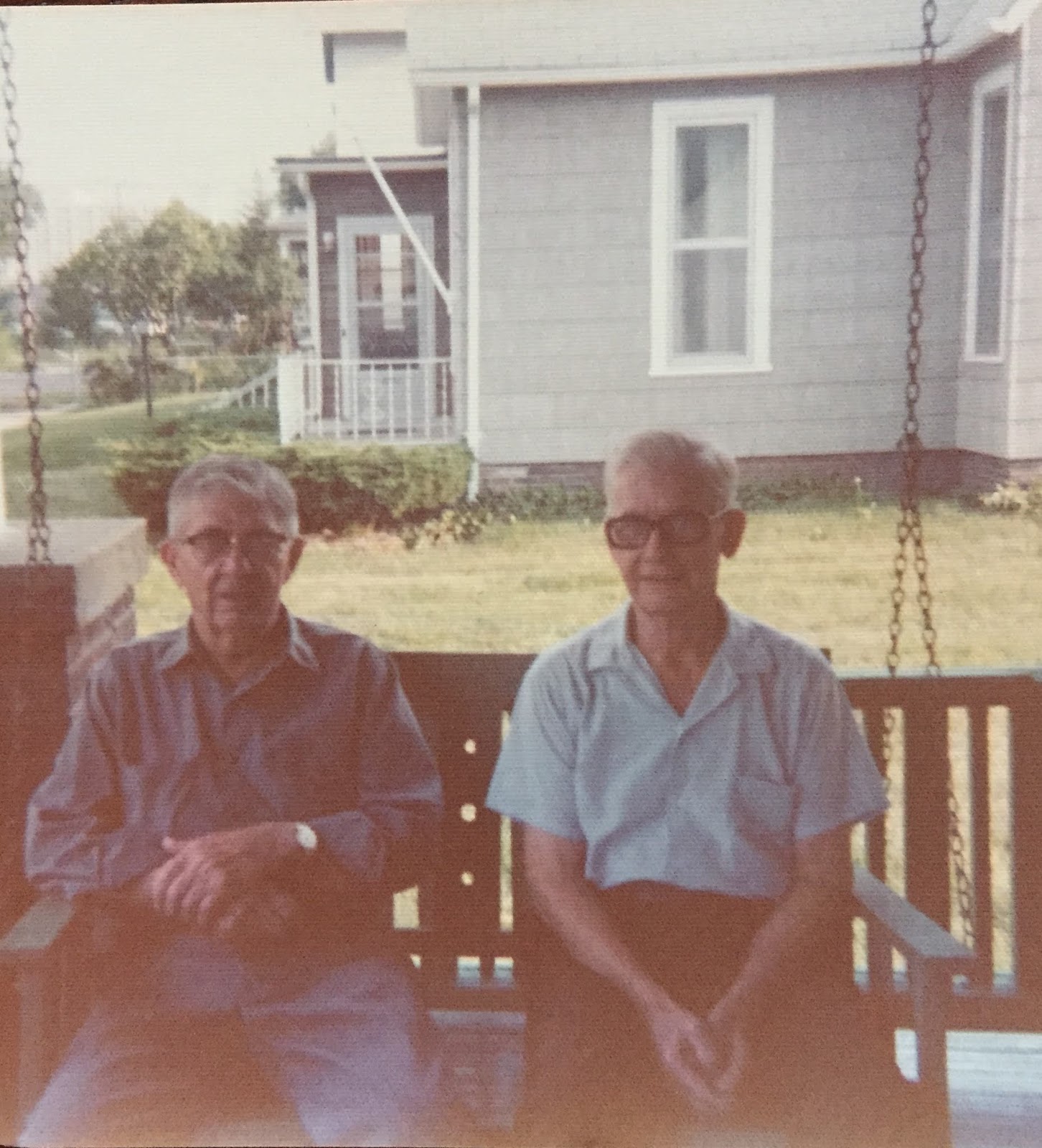
This is one of my favorite pictures of our beloved Peter and Frank Linn, brothers sitting on the front porch swing in Des Moines, 1979.


My dear grandparents, Peter Edward Linn and Maude Edith Olofson Linn.


And on the Olofson side: Olivia Rask Olofson, my great-grandmother, died in 1943. Below is the sale of her farm shortly after her death:

You can see the total price, followed by expenses and the distribution to her 3 children.


And below is a copy of Olivia's Last Will and Testament, a very simple one, leaving everything divided among her 3 children:

 At the time Olivia wrote this, she states that she is 62 years old, meaning it would have been written in 1921. Yet, the date is 1924, about 8 months after her husband's passing. It's clear that Olivia is still holding on to the belief/story that she was born in 1862, not 1859. We all know better and have the proof in her birth record and Swedish clerical surveys.


William Edward Olofson and Olivia Rask wedding photo, 1889

In a previous post, I placed a portion of the Linn and Lundblad ancestors in a chart. Following is an Olofson/Barquist tree:


The two Olof Rasks is not an error. Father and son had the same name.

I've traced our ancestors in all of these lines several more generations, but I hope this helps put many of our ancestors into a visual for you.

I'll keep looking through old family photos and post some interesting ones before the end of the year. Do you have one you'd like to share? If so, please send it and I'll make sure it's posted for others to enjoy.

Sunday, October 21, 2018

Multiples

We seem to be a family with very few multiple births. The only modern day multiples I know of are the twins born to my cousin Joel and his wife in 2002. But we certainly aren't known for our multiple births. Yet, there is ONE that I can report on in this post.

Kerstin Larsdotter is my 3rd great grandmother on the Olofson side. She was born to Lars Larsson and his wife Greta Ericksdotter in Farila Parish in Gavleborg County. Kerstin was one of 5 children born to this couple, and she is a twin.
  • Son Lars, born July 27, 1800
  • Son Eric, born April 23, 1802
  • Daughters Kerstin and Marta (or Martha), born May 4, 1804
  • Daughter Brita, born March 2, 1807
Marta and Kerstin, twins, born May 4, christened May 5, to farmer Lars Larsson and his wife Greta Ericsdotter in Fone (the farm in Farila Parish). The mother was 36 years old; the last column contains names of witnesses


So, maybe there's nothing too remarkable about one set of twins. But let's take a closer look at Kerstin and Marta.

Every year in Sweden, the priest would conduct a clerical survey of each household in the parish. His goal was to check on the knowledge of the Bible that each family member had, vaccinations, determine any births, marriages or deaths that occurred in the past year, and who might have moved in or out of the parish. The records are incredibly useful to a family historian and very detailed.

In several clerical surveys for Farila Parish, Marta Larsdotter is shown as having epilepsy. In the early 1800s, there would have been no treatment for epilepsy, and the physical toll it would have taken on Marta would have been tremendous. Marta died at the age of 24 on June 18, 1828. The cause of death was listed as convulsions.

The farmer Lars Larsson's daughter, Martha of Fone (the farm) died of convulsions on June 18, buried on June 22. She was 24 years, 1 month, and 14 days old.

Marta was the second child in this family of 5 children to die. In 1827, older brother Lars died of a "nerve fever" (perhaps rheumatic fever). Lars' and Marta's deaths left just 3 siblings in this family, one being the surviving twin Kerstin.

We know that Marta had epilepsy that was recorded by the parish priest in each yearly survey, but twin Kerstin also suffered from a life-long problem. My 3rd great grandmother was listed as being "hard of hearing" in several clerical surveys while she was growing up.

In case you don't know how Kerstin fits into our family, she married Olof Olsson in 1834. They had 6 children before immigrating to the United States in 1850, settling in Wisconsin. They lost their youngest child during their immigration. The family of Olof, Kerstin, and 5 children lived in Wisconsin where Olof died, family stories indicate from a logging accident. No one researching this family has found a location or date of his death. Another family story has Kerstin (now known as Christine Olofson) walking with  her surviving children to Iowa where she settled in the Stratford area. 

Christine Olofson's son Olof Olofson was my second great-grandfather, his son William Edward Olofson was my great grandfather, and Maude Edith Olofson was my grandmother.

I've not seen a mention in any record in the United States that Christine Olofson (Kerstin Larsdotter) had difficulty hearing, but I have no reason to doubt what the priest wrote in every yearly survey in Sweden.

And so, to my knowledge (and with apologies if I've left out a multiple birth in our family), we have just the two: Joel's and Lars', 198 years apart. I feel safe in saying that our Swedes aren't known for multiples!

Sunday, September 30, 2018

A Weekend With Grandma

Today's post will be a short one as I just returned from Iowa where my brothers and I went through our 93-year old mom's 10 x 20 storage unit. We organized, tossed, and labeled the items she had accumulated and saved.

We laughed at some of the things we found and the number of funeral notices and obituaries that she had in duplicate, triplicate, and more. Recipes cut out of a magazine that were never used and every birthday, Christmas, or Mother's Day card she had ever received! I cried when we talked about our memories or saw items that had belonged to our grandparents. We talked about the school books, some dating to the late 1800's that now were moldy and not salvageable. And I was saddened by the huge number of photos, mostly unlabeled, that will one day be tossed because we can't identify the subjects.

It was an emotional week. And now mom's 93 years are downsized even more, from a 10 x 20 unit to a 10 x 10 unit. 

For all of us, I ask that we label photos or cherished family items for future generations so they will survive and be enjoyed beyond our time. I wrote the following post a couple of weeks ago, and today it seems most appropriate:


Do you have an item from one of our relatives or ancestors that makes you smile or remember a special time?

I have a few small items from my grandparents, and even a couple from great-grandparents. A vase. A teapot. A dish. A violin. None are worth any large sums of money. Most were items that they used, that I remember, that I saw in their houses.

My Grandma Linn (Maude Edith Olofson) was known to some to be a difficult woman with a temper and a memory to match. I never saw any of those characteristics. To me, Grandma was a great cook (although the only way I could stomach the lutefisk was to smother it with white sauce and dump a ton of cinnamon on it), a left-handed crocheter,  a lively piano player, and a hugger who always wore shirtwaist dresses and had her short curly hair perfectly arranged.

Grandma and Grandpa had 5 sons, then 2 grandsons, and then me. Maybe there was a special bond between us as she had to be a bit weary of seeing nothing but males in the family. But whatever the reason, I always had a good time visiting with Grandma and always loved eating anything she cooked.

We all know about Grandpa's bleeding ulcers and how he suffered with them. There were times he spent at the Veteran's Hospital for treatment of his ulcers. And during one of those stays, when I was 11 or 12, I spent a couple of days keeping Grandma company.

At that time, we lived just a block away. Grandpa and Grandma lived in a one-story, two-tone bungalow at 1430 5th Avenue. We lived at 1464 Fourth Street in a two-story house built in the late 1800's that had a horse barn/garage behind the house, complete with steps to a second floor attic. That was where all of our toys were stored, where we often played. It was just a short walk through the alley, around the corner, past the World War I shell-shocked man and a few good friends' houses to reach Grandpa and Grandma's house.

I had many times alone with Grandma, many times that I wish now I had asked her questions about her own parents, about traditions, about the photos she had on the mantle. How I wish I had asked her about life on the farm, about her memories of her grandparents, about how she and Grandpa fell in love. But I didn't.

When I stayed with Grandma, she sat me down in the kitchen at the back of the house, next to a large bucket of apples. We were going to make jars and jars of applesauce, and my job was to use the apple corer/peeler to start the process. We had a great time, a special time, that I will always cherish.

And I have that apple corer/peeler today. Every time I see it, I think of Grandma and the time we spent, just the two of us, making applesauce.


Grandma's Rusty Apple Corer
Do you have an item from one of our ancestors that you cherish? I hope that most of us do. And I hope that these items stay in the family, being displayed, passed down to the next generation so they know some of the stories about their family.

If you ask my siblings, they will tell you that I just might border on being a hoarder. I would not agree. But what I would say is that these items, when gone, are gone forever. Photos. Vases. Military uniforms. Recipes. Family Bibles. Please don't toss what you have. If you don't have anyone in your family willing to take these treasured family heirlooms, I'm here. And I promise to take good care of our family history in all of its forms and do my best to pass it on to the next generation.

Want one of your items displayed on this blog? Send me a photo and a story and we can all enjoy. I've spent alot of time these past few days while writing this post, just thinking about my Grandma. And each time I did, I smiled, just remembering that one special day, but also so many special days we had, whether playing cards, listening to her play the piano, or eating her great food.

I hope that you have an item that brings back those same kinds of memories.

Sunday, July 1, 2018

Olof Olofson - How did no one know THIS?

Olof Olofson was my second great grandfather, the grandfather to Maude Edith Olofson Linn. Today's post is about his life, but first, when you look at the picture below, does anything stand out to you? The answer will be at the end of this post.


Olof Olofson. 

Olof Olofson was born in Farila Parish in Gavleborg County on October 5, 1837, the second of 6 children born to Olof Olsson and Kirstin Larsdotter. In 1850, Olof and Kirstin brought their 6 children to the United States, which was rather early for Swedish immigration. They settled in Manitowac County, Wisconsin, having lost their infant daughter along the way. Olof Olsson died in Wisconsin, and the family story is that Kirstin walked with her 5 surviving children to Iowa where she settled near Stratford and raised her family.

In 1865 Olof married Maria Barquist. Their son William Edward Olofson was born in 1866, and three years later, their daughter Mathilda was born. Sadly, Mathilda died in February 1870. The story becomes blurry about Maria at this point, but by 1880, we know that Olof had remarried to Brita Rask. In one record, Olof is listed as a widower; in another census he is listed as divorced. To this date, no one has been able to learn what happened to Maria Barquist Olofson.

Olof and Brita had 7 children together in addition to Olof's William Edward Olofson and Brita's Anna Sophia Charlotta. They lived very modestly in Hardin Township, on 30 improved acres and 40 unimproved woodland or forest acres and 19 unimproved "old fields" not growing wood, according to the 1880 U.S. Federal Census Non-Population Schedule (Agriculture). The value of the farm was $1600; value of livestock $450.

According to the regular US Federal Census data, Olof did not own his own farm until the 1920 census, just 4 years before he died. Until then, they were renters and also had boarders living with them. Imagine all of those people in a small, modest farm house!

The children were

  • William Edward Olofson, 1866-1924, married to Olivia Rask;
  • Anna Sophia Charlotta Olofson (Lottie), 1879-1931, married to Oscar Emil Larson;
  • Hannah Margurite Olofson, 1881-1965, married to William Leon Brundien;
  • Alice Olofson, 1883-1963, married to Henry V. Larson;
  • Gilbert Olofson, 1886-1976, married to Iva Pearl Woolsey;
  • Charles Olofson, 1889-1911, died working in Chicago;
  • Delbert Olofson, 1891-1920, married to Golda Mae Snyder;
  • Bada Olofson, 1893-1971, married to Clement Lincoln Johnson;
  • Leon Olofson, 1896-1967, no information on a marriage.

One of the interesting features of this family, unusual at the time, is that, several of the children had moved far away from Iowa. Alice died in Tacoma, Washington; Delbert in Truman, Minnesota; Bada in Long Beach, California; and Leon in Lacombe, Alberta, Canada.

And so, back to the question I asked at the beginning of this post. Here's another photo for you to examine:

Olof is in the lower left.

Is there anything you might be noticing now? No, it's not the beard, although it's pretty fantastic! I have to admit that I didn't notice something about Olof for all of the years I've had these photos. If you have a guess, take a look at this obituary for Olof that I just found a couple of weeks ago.


Notice halfway down where the article mentions his being blind for 40 YEARS!
Webster City Journal, July 24, 1924, page 5

This is the first time I've heard or read of his being blind. And Olof was blind for nearly half his life!! How did he farm? Did any of my readers know this? Please comment on the blog if you have any insight.

I love genealogy research. I find out something new every time I look at a new record, read a news article, exchange information with other descendants, read about the history of the time. I hope you're enjoying these posts as much as I enjoy writing them.

Sunday, May 13, 2018

Mother's Day


On Mother’s Day, appreciation and thanks to these Swedish moms who came before me, the women I research and try to bring to life for others to know:

My grandmother: Maude Edith Olofson Linn (1897-1973)*

My great-grandmothers: Olivia Rask Olofson (1859-1943) and Elin Mathilda Andersson Linn (1867-1925)

My great-great grandmothers: Catharina Lundblad Linn (1823-1912); Anna Maja Abrahamsdotter Anderson (1832-1918); Maria Barquist Olofson (1842-?); and Sophia Margrita Kjellander (1822-1888)

And the many, many female ancestors whom I appreciate for their strength, courage, and abilities that trickled down from generation to generation to give us life. Some of these women endured extreme hardship or poverty, the loss of a spouse and children; some raised their children as single mothers; some had a dozen children or more and some died in childbirth; some crossed the ocean to find a better life. Others said goodbye to their entire families and never saw parents or siblings again. All were women who, through their strength in being the heart of the home, their courage in traveling across the ocean for a better life for them and their families, or for their education and pioneer work in medicine or teaching or other fields, fill me with pride.

All of them, each of them, is a part of each of us and we are a part of them. I honor
each of these mothers and their place in the history of our family…the Linns. And to my blog readers who are mothers, I send you a HAPPY MOTHER'S DAY as well.


*Yes, I believe Grandma Linn that she was born in 1897, not 1896. Contact me for details as I used this as a topic I presented at my local genealogy society.


Maude Edith Olofson Linn

Sunday, April 15, 2018

A Swedish Soldier


Last fall I decided to put together what I know about my military ancestors, those who served in the Czech Republic, Sweden, and the United States. There were over 25 of them, serving their country during times of war and peace. Periodically, I will include one of our Swedish soldiers in my blog.

In Sweden, after 1692, the soldier allotment system worked this way: A number of farms made up a rote, and each rote was responsible for one soldier. The farms had to recruit the soldier, give him and his family a cottage and piece of land, and pay a salary. During peace time, the soldier would do military exercises with his regiment and be called upon to provide other duties. In times of war, his family and farm were taken care of while he was gone. If the soldier died, the soldier’s family had to move to make room for the next soldier. And when the soldier retired, he and his family immediately left the farm.

One of my Swedish military ancestors was my 4th great grandfather, Martin Hedberg. He was the great-grandfather to Olivia and Brita Rask (Olofson). Martin was born to the soldier Olof Boman and his wife, Anna Martensdotter on February 4, 1745, in Bollnas Parish in Gavleborg County.

Having researched my family history for over 40 years, I know that not every person lives up to the ideals we might hope for or live the kind of life we might imagine. Often, their lives have both positive and negative parts to them, the ups and downs of life. Martin was one of those ancestors.

Without a full history, complete explanations and details, it's difficult to know when the few facts available lead to an accurate assessment of a person. I don’t have exact dates when Martin served as a soldier. It’s my guess that he was discharged or retired by the 1783-1786 clerical survey when we see Martin moving several times, from farm to farm, within Bollnas Parish. He did not have papers that allowed him to move, was not able to pass the yearly clerical examination given by the parish priest, could not read, did not know the Bible or was able to recite anything he was asked. Because of these shortcomings, Martin Hedberg was sent to work at a fortress in 1786, probably Fredriksskans in Gavle to work at hard labor. It would have been similar to a prison.


Fredriksskans Fortress


Fredriksskans fortress was erected on a small island on a fjord and was originally used as a fort for protection of the area, but later became a prison. Martin was there from 1786 but would have been out by 1789 as he fathered a child then.

By 1798, Martin was living with Ella Palsdotter and their illegitimate children. Anna (born 1789) and Olof (born 1792). Martin is noted as being a discharged soldier in the clerical survey. To date, I've never found a marriage record for Martin and Ella, and their children were always listed as oƤkta or illegitimate.

Martin’s death record states that he was a retired guard, receiving a pension from the military. He died on April 30, 1807, at the age of 62.

It's important to note that, in Sweden, under the Lutheran Church, the yearly clerical surveys conducted by the parish priest were taken very seriously. These examinations helped the Lutheran State Church in its responsibility to keep track of its people. They also served as an opportunity to teach church doctrine, reinforce disciplinary authority (thus the punishment for Martin Hedberg), and promote a healthy society through the recording of vaccinations. Anyone who could not meet basic church requirements would have been penalized in some way.

While it's clear that Martin Hedberg honorably served his parish or rote as a soldier, he was unable to maintain a lifestyle that satisfied the state church. Perhaps he was simply poor which led him to move around and to not learn to read or study the Bible; perhaps he was defiant of the church doctrine and rules. I have no answers to the "why's" of Martin's life and the decisions he made. But we are descended from his son Olof, grandson Olof Rask, great-granddaughter Olivia Rask, and great-great granddaughter Maude Edith Olofson. For that I'm thankful.