My ancestors came from both Sweden and Bohemia, settling in Iowa. Through this blog I hope to share information with my own relatives about my Swedish ancestors. Please comment or share any interesting and relevant information you have on this family line.

Tuesday, October 31, 2023

Renter, Tenant Farmer, or Sharecropper?

My grandparents, Peter and Maude Linn, didn’t own their farm south of Dayton, Iowa. But what was the nature of their lease? Were they cash renters, tenant farmers, or sharecroppers? From the time they married in 1920 until they moved in the late 1940’s, they farmed the 160 acres and lived in a house that had no running water or reliable electricity.

In 1948, Peter and Maude Linn, along with their 3 youngest boys, moved from the farm near Dayton to 1615 Arlington Avenue, in Des Moines. A large, stately house set on a large lot, this part of Des Moines had been the area in which the rich and well-connected professionals had lived in previous decades. They rented rooms to lodgers, and the 1950 US Federal Census shows Peter, Maude, sons Ellis, Ivan, and Merlyn, and NINE lodgers.

So, what became of the farm 2 miles south of Dayton? As a Litchfield Farm, another renter/sharecropper was needed. That’s when my family moved in and started to farm. But were we renters, tenant farmers, or sharecroppers?

At the bottom of this post is a lease agreement link for the Litchfield farm made between my parents and Litchfield. You may not be able to read all of the details, but let’s look more closely at a few important parts to this 1956-57 agreement. The property consisted of 160 acres, some of it forested, some pasture, and some cultivated land.

You may see the words “Crop Share” under RENTAL toward the top of the page. Before reading on, let’s learn about the differences among share croppers, renters, and tenant farmers:

In Iowa, many of the farmers were tenant farmers, meaning they likely paid part of the rent in cash and part to the owner in crops; and they sometimes were called “share croppers”. While the words tenant farmer and share cropper were used interchangeably, there were differences, depending on the contract that was written. A true sharecropper was considered to be the “poorest of the poor” in that they provided ONLY labor for the owner of the property. They were unlikely to ever be able to move up or out, never be able to buy their own land or make any real money. They had to use the seeds and equipment provided by the owner, plant what the owner demanded, and pay for their living arrangements with a percentage of the crops.

A cash renter was just that. The rent agreement was paid solely in cash. The crops, and money for those crops, were those of the renter, whether it was a good year or a bad year.

By contrast, a tenant farmer's contract usually contained provisions for both cash rent plus a share of the crops with the landlord. A good year was good for both; a bad crop year (caused by disease, drought, early winter, or other reasons) was bad for both. In even the best of situations, sharecropping families lived in a house and on land that was not their own and, without any notice, they could be evicted by their landlord. In addition, like the "company store" of Tennessee Ernie Ford's song, sharecroppers could be forced to pay elevated prices for seed or pasture land and split any profits in an unfair way. On the other hand, a tenant farmer's agreement normally called for notice to the farmer to vacate the land; and the same was true for a cash renter. 

Often we see in an obituary or in a life sketch that a person was the son or grandson of sharecroppers. You may think, as I did, that sharecroppers were only, or primarily, black? However, approximately two-thirds of all sharecroppers in the United States were white, and one third were black. However, both groups were at the bottom of the economic ladder.

By the 1940s—with increased mechanization and better-paying jobs in urban areas—sharecropping began to disappear in the United States, though some form of it still exists in a handful of areas. Sharecropping, however, is routinely practiced today in a few countries such as Bangladesh, Ghana, Zimbabwe, India and Pakistan. 

Of all acres in Iowa as of July 1, 2022, 7 percent were said to be under a crop sharing agreement which represented 12 percent of all leased land in Iowa. 

So, what happened to these renters or sharecroppers during the Great Depression? 

My mother always said that her family and her other relatives fared well during the Great Depression. They had plenty of food and animals and were able to keep their economic heads above water. But they actually OWNED their farms.

But for those who had high mortgages or didn’t own, including Peter and Maude Linn, what happened to them during the Great Depression? In general, farmers did struggle with lower prices, and, at some point, may not have been able to pay the rent on their farm or hire laborers for various jobs around the farm. I learned that Peter Linn (my grandfather) found that he couldn’t make any money by selling the pigs he had raised and was ready to just slaughter them all to have the meat and to stop the cost of their feed and upkeep. He was talked out of that at the time. But many farmers were making desperate decisions IF they were not able to keep up with the rent and other costs.

Some farmers in Iowa became so angry that they blockaded the transfer of milk to cities and towns, hoping that might drive the price up. In some cases, the price for a bushel of corn fell to just 7 or 8 cents. And during this time, some farmers declared bankruptcy.

Peter Linn, as a renter, and other farmers in our family who rented, felt the pressures of the Great Depression.

Farmers Grow Angry and Desperate:

The Great Depression Hits Farms and Cities in the 1930s | Iowa PBS

The Great Depression Hits Farms and Cities:

https://www.iowapbs.org/iowapathways/mypath/2591/great-depression-hits-farms-and-cities-1930s

Continuing the look at the agreement between Litchfield and my family in 1956, there is a section covering “who pays for what”. In our case, the following were included:

Tenant is to deliver at the Dayton or Wolf Station free of charge, in elevator, crib, or car, one-half of all corn, two-fifths of all oats and soy beans, and one-half of all other grain raised on the leased premises as lessor may direct. [We were paying in crops.]

Tenant pays one-half of cost of hybrid seed corn. Tenant furnishes all seed other than corn. [Somewhat of a split on corn seed.]

Tenant pays cost of threshing or combining oats and soy beans. Each party pays one-half of all other threshing. [A shared cost.]

Tenant pays $35.00 for pasture rent, $5.50 for meadow rental per acre for one cutting and $10 per acre for two or more cuttings.

Tenant agrees that he shall not be entitled to any compensation for buildings, repairs or other improvements … unless expressly consented to by lessor beforehand in writing.

There is much more to learn about these farm arrangements, but based on what you have read and your look at the 1956-57 agreement between Litchfield and my family, what do you think? Were we renters, tenant farmers, or share croppers?


Tuesday, October 17, 2023

Death at Sea

 In the 1840’s and 1850’s, when our first Linn and Olofson ancestors immigrated to the United States, deaths from disease, accidents, and other means were not unheard of. While many studies have been done about mortality on slave ships, little has been done to document immigrant deaths from Europe to the United States.

I’ve known about a couple of deaths in our families aboard ship, but I wanted to know a bit more about how common this might have been and about the disposal of their bodies.

Estimates of ship mortality were reported in The Journal of Economic History, Raymond Cohn, Vol. 44, No. 2, pages 289-300. In that article, mortalities were summarized:

The years 1849 to 1853 certainly caught my attention. As I continued to read this article, it became clear that few studies were done and that the results reported varied a great deal. A report by the United States Senate Select Committee on the Sickness and Mortality Onboard Emigrant Ships, No. 386, 1854, stated that .80 percent perished on ships arrived in New York harbor during 1853; .63 percent in 1854; .21 percent in 1855; and .21 percent in 1856. However, many reports claimed that mortality onboard ships was at 2 percent or even higher.

Certainly, our ancestors were cramped in steerage for the long trip across the ocean. Disease, such as cholera, was prominent, and those who were vulnerable, such as the very young or very old, were susceptible to serious disease or dying.

Olof Olsson and Kristin Larsdotter (my 3rd great grandparents) made the trip with their 6 children, including my second great grandfather Olof Olofsson,,sailing on 3 September 1850 on the Swedish Brig Maria from Gefle to New York. Olof Olofson, farmer, age 42; Christina, age 46; Lars, age 15; Olof, age 11; Anna, age 9; Margareta, age 7; Christina, age 5; and Karin, 10 months were listed on the ship manifest.

It is the baby, Karin who died, listed as dying in New York, but likely at sea and recorded when they disembarked. I have no additional records for this death. New York, as with most states of the time, was not keeping regular death and burial records.

Peter Linn (born Olaus Petter Olausson) and his wife Sophia and their children boarded the Preciosa to New York, arriving on 8 September 1851. They were listed as Olaus P. Olofson, age 28, a farmer; wife Sophia, age 28; son Johan E, age 2; and son Ol. Leon, age 4 months. They are listed as being in a cabin. Below them are people "between deck" which sounds horrible.

In this case, it was Johan Edward, age 2, who perished on the voyage on 1 August 1851. One son had already died in Sweden; Olof Leonard, the baby, died in 1852 in Iowa; and this family lost child after child of the 7 they had, with only one growing to adulthood.

Johan Edward passed on 1 August, yet the ship didn’t land in New York until 8 September. One would guess that his body would have been buried at sea with a simple ceremony done.

To lose a loved one is always difficult; to lose a young child is more than just heartbreaking. And then to know that child was not given a proper burial with a spot one could visit is hard to even comprehend.

This is just a short look at two deaths at sea, both young travelers from our family line. Somehow our ancestors were able to keep going until they reached their destinations. The Olssons in Wisconsin; the Linns in Iowa.

Thursday, October 5, 2023

The Iowa Cow Wars

 No, that's not a joke. 

Before I tell the story, I want to thank the author of the Instagram account, notesoniowa and website https://www.notesoniowa.com/  for his daily history lessons on Iowa. While I spent the first 25 years of my life in Iowa and thought I knew most of what makes Iowa great, I have learned a great deal from his daily posts. Please follow him on either account to enjoy learning more about Iowa.

So, the Iowa Cow Wars was posted on notesoniowa on September 21 and, of course, piqued my interest. In 1929, just as our nation was approaching the Great Depression, Iowa passed a law requiring all farmers to have their cattle tested for tuberculosis. Veterinarians were sent to test all cows and eradicate those that tested positive for tuberculosis. You can imagine the economic hit that would take to some farmers. It was estimated that for every cow lost, the farmer lost $130, not a small amount at the time. During the fall of 1931, and, with the aid of inaccurate information being disbursed to foment farmers, many became unwilling to cooperate and staged protests.

In late September 1931, these protests reached a head in Cedar County. When protests and pleading with the State Legislature didn't work, the angry farmers headed to Tipton, Iowa, where testing was taking place. Pitchforks, rocks, and other crude weapons were used by the farmers to face off with the veterinarians and their security.

Governor Turner sent about 1,000 National Guardsmen with machine guns to calm the situation. The last of the Guardsmen left in late November and testing continued. 

When I look at the newpapers where our ancestors lived (Dayton Review, Fort Dodge Messenger, etc.), I see nothing about the Cow Wars. A few short articles appeared in Hamilton County newspapers which included the Stratford area. But this lack of news attention leads me to believe that the farmers in Webster and Hamilton counties probably cooperated with the TB testing of their cows. Still, it's an interesting look at an important issue in Iowa when our ancestors were farming. At the very least, they would have been aware of the law, the disagreements, and the impact on their livelihoods. 


Tuesday, September 26, 2023

Ivan Linn Talents

The five Linn brothers were/are very musical, gaining an appreciation for music from both their parents, Peter and Maude Linn. Whether it was singing, dancing, playing an instrument, OR a combination of all three, each of the Linn boys was musically talented.

For a time, brothers Ellis and Ivan formed a group that entertained in and around Dayton. Ellis was and still is a great pianist, and in my fondest memories, played the great old honky tonk songs that Grandma Linn also played. Stanley, Rolland, Ellis, Ivan, and Merlyn all had rhythm, using their talents on the dance floor with the ladies or entertaining others.

Ivan Linn was certainly no exception. With much financial hardship, Peter and Maude found a way to pay for Ivan's dance lessons where he excelled at tap. 

While attending a Navy school at the Naval Air Technical Training Center in Norman, Oklahoma, Ivan entered a contest in Oklahoma City, and was chosen as the winner out of a group of 235 contestants. This gained him the attention of Ted Mack scouts who invited him to appear on the Ted Mack Amateur Hour, an early version of American Idol-type talent shows where the audience voted for their favorite. 

I am delighted to be able to share with you the video of the entire Ted Mack program from September 26, 1952. Ivan is the second entertainer in the video.

https://clipchamp.com/watch/USvTHxDcxAW

And following are two news articles about Ivan's appearance on the Ted Mack Amateur Hour in 1952 and at the American Legion in Fort Dodge as a child.


On a little side note, I found Mrs. Helen Childs (age 38) in the 1940 US Federal Census, living with her husband Walter (age 40) at 1111 Union Street in Boone. She is listed as a dancing instructor with her own studio. Her husband was a brakeman for the railroad. No children listed.

Just another proud moment in our Linn history. Thanks, Ivan, for sharing your talents with all of us.

Wednesday, September 20, 2023

Linns From A to Z

Once again, I'm just poking around my ancestral tree, looking for an interesting ancestor or someone I'd like to know more about. While looking through all of the Linns in my genealogy program, I counted 141 with the surname LINN. And this 141 doesn't count those who married into the family and took the Linn name.

There are 3 with the first name Mary; 3 with the name Maria; 4 Donalds; and the winner is John with 7. My list of Linns starts with my cousin Alan and ends with my 2nd cousin, twice removed, Zona Linn. Since Zona is an unusual name, I decided to take a closer look at her.

Zona was born in Minnesota on 28 April 1902 to Louis S. Linn and his wife Florence Stafford, their second child. Shortly after Zona's birth, her mother Florence died. Louis remarried in 1910 to Anna Brockman, who brought 3 more children to the marriage.

The name Louis S. Linn may mean nothing to us, but Louis' parents should sound familiar. Louis' father was Lewis Linn, the stepson of John Linn. Lewis took the last name Linn when John married his mother Sarah Svensdotter. Lewis enlisted in 1863 to fight in the Civil War. He joined the regiment at Athens, Alabama, where he remained for six weeks and then started with Sherman in his memorable march to the sea. He was in two engagements with Sherman in the Carolina campaign. He was later transferred to the 7th Iowa Infantry. He was twice wounded in engagements, and this permanently disabled him. He was mustered out of the service about July 1865 with a most creditable military record.

While Lewis Linn is not a direct ancestor, his wife certainly is. Kerstin Olofsdotter is my 3rd great aunt and sister to my 2nd great grandfather, Olof Olofson.

Back to Zona. In 1920, at the age of 17, Zona married Delbert Rouch, age 25, in Michigan. This marriage, however, didn't stand the test of time as they divorced sometime before the 1930 census. The divorce probably happened before 1925 as I find Delbert Rouch, a carpenter, living by himself in his home state of Indiana. And, in 1930, I find Zona, divorced, working as a telephone operator and living by herself in Minnesota. 

In 1933, Zona marries Thomas Tomek, an orchestra musician of Bohemian descent, who was 7 years Zona's junior. I would venture a guess that Thomas played in a Czech group that played polkas around the Midwest. For a time, they lived in Chicago which had a large number of Czech/Bohemian families.

While it doesn't appear that any children were born to this couple, they had a long marriage until Thomas died in 1987 in Minnesota. Zona passed in 1992. Both are buried at Saints Cyril and Methodius Catholic Cemetery, Taunton, Lyon County, Minnesota.

So, like most of us, Zona Linn lived a normal, but fairly unremarkable life. Still, I'm happy to share her with you and keep her name alive.


Zona and her brother Lyle were from Louis S. Linn and Florence Stafford Linn's marriage.


Thursday, August 31, 2023

Pictures--Mostly Olofsons

Today, I was looking through my Olofson records and came across several photos that I thought would be of interest. There are people I recognize or that my mom helped me label, but you may recognize some faces and can fill me and others in.

This first picture is taken outside Olof and Brita Olofson's farm house from around 1902. I wonder if Maria Barquist had also lived there??? From left to right are Henry Gilbert, Carl Henry, Delbert August, Bada Maylinda, and Leon. Behind them are Olof and Brita. Doesn't that house look small? Even for just the 5 youngest of their children along with the parents?


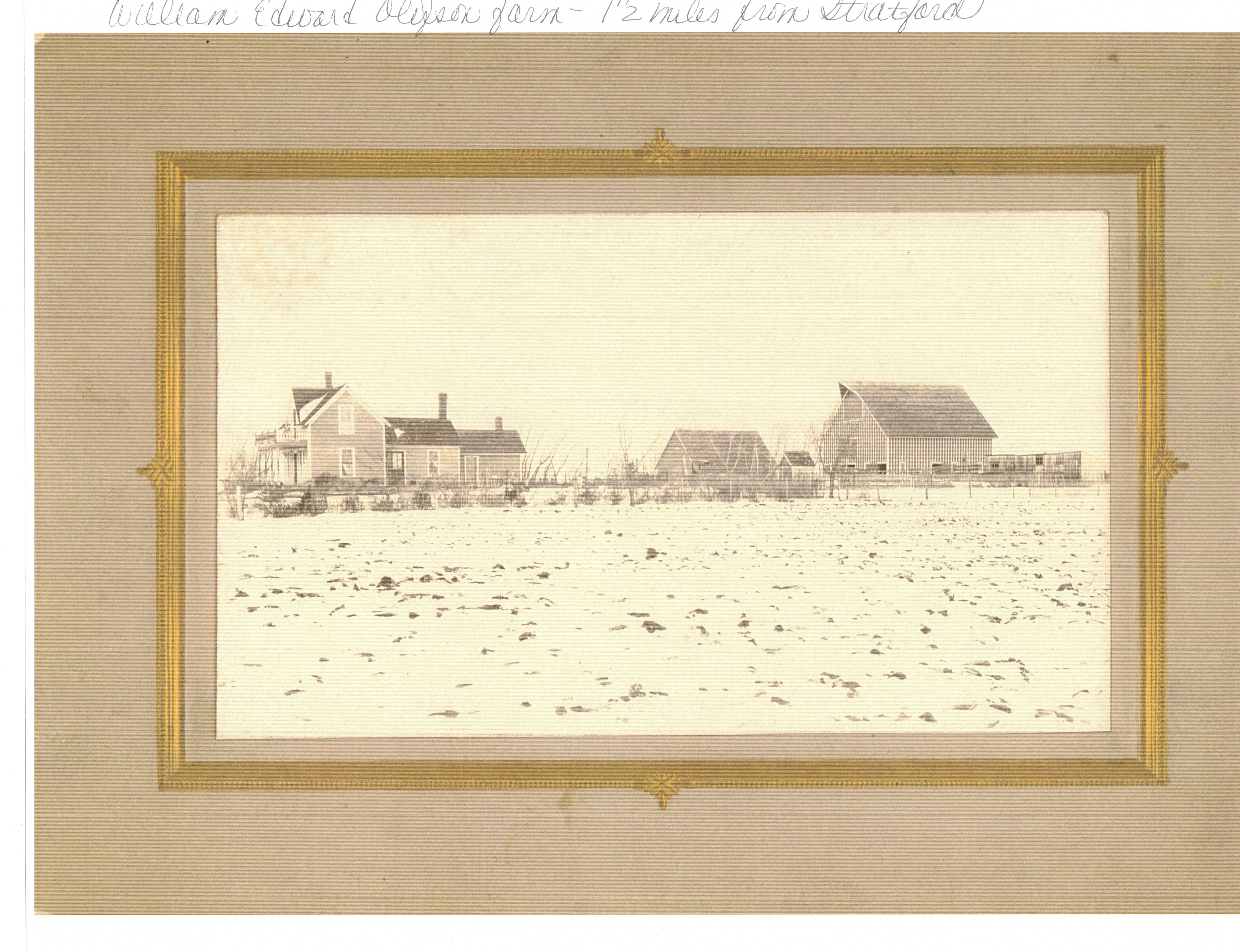
This next picture is a wide view of William Edward Olofson's farm. Many of us have seen a photo of the front of the house, but this view gives us a sense of a much larger house than the one William's father had lived in--with fewer children!


These adorable girls are two of Olof and Brita's children. Bada was born in 1893; her sister Alice was born in 1883. It looks as if this photo may have been taken around 1896.


Bada appears again in the next picture with four of her brothers. Back row: Charles, Gilbert, and Delbert Olofson; front row: Bada and Leon Olofson. Don't all of their little Olofson faces look similar?


This next photo shows the front of William and Olivia Olofson's home, a photo many of us have seen. On the front porch are Maude and Lilly. Also standing on the porch is mother Olivia. I don't recognize the others. Do you?


Below are two photos of the school that Peter, Frank, and Maude all attended. In the top photo, near the right side is Maude, but I don't recognize others.


And finally, two entrees for the Olof Olofson family in the Stratford Evangelical Lutheran church records:


I hope you've enjoyed this look at the homes, schools, and church records for the Olofson ancestors. I'm always looking for additional family photos, so please go to the attic or back of that closet and see what treasures you may find to share.

Monday, August 21, 2023

The Land They Bought

Many immigrants came to the United States for the opportunity to own land. In Sweden, with the exception of just a couple of my ancestors, none of the Linns, Olofsons, Barquists, Anderssons, Rasks, and others were able to own a piece of land. While there are other reasons for migration (religious freedom, escape military service, and more), being able to own land was a very important reason for our ancestors to leave their family, friends, and homes.

Here is just a brief look at some of our ancestors' early land purchases:

Peter and Sophia Linn: Arrived in Iowa in 1851.

Through the Bureau of Land Management, they purchased 40 + 20 acres of land in Boone County on June 5, 1866. Township 85 North; Range 27 West, Section 3. Link here: Description of Land

Gustus and Catharine Lundblad Linn: Arrived in Iowa in 1853. By 1855, Gus and Catharine were buying and selling land.

One early transfer of land  on 24 May 1855 when Gus (grantor) to Peter Runyan (grantee), a man who had been born in 1787 in New Jersey and had made his way to Iowa and Boone County where he died in 1871. 

Also in 1855, Gus was on the purchasing side of land on 14 August 1855 from Andrew Kaulson; and on 4 September 1855, Gus sold land to Charles Munson. 

John and Marget Barquist: Arrived in Iowa in 1858.

Through the Military Scrip Warrant Act of 1855, the Barquists were able to purchase land along the Des Moines River that had been gifted to a Civil War soldier as payment and appreciation for his service. The 160-acre Barquist land in Webster County was bought on June 1, 1866. Township 86 North,  Range 27 West, Section 23. Link here: Description of Land. As you may recall, this is the land that was forcibly taken from John and Marget with the lawsuits going to the US Supreme Court for a final decision.

 John Linn: Arrived in Iowa in 1849. 

I'm not quite certain when John and Brita OR John and Sarah bought their first land, but on 3 May 1856, John and Sarah sold land to the School District of Hardin Township in Webster County for $10 to be used  to build a school. It was in Township 86, Section 26, Range 27 and contained 80 square rods which computes to half an acre.


The above plat map for Dayton and Hardin Townships was from 1909, much later than the sale of land in 1856. The owners of land clearly are not the same as they would have been in 1856. But we can see the Des Moines River and, to the right, sections 27 and then 26. It is in Section 26, around the name Berglund, that the school would have been built.

An accounting for the school shows that John Linn continued to support the school by giving money to a teacher fund, being paid $1.30 for a bucket and a tin cup for the school (1860), being paid $2.00 for work and lumber furnished for the school house (1860). This information was all found in a very brittle book on the accounting of the Hardin school. 

In 1859, I also show John Linn owning 80 acres in Section 27 of Hardin Township. For a time, he co-owned it with a man named Frederick Carlson, no relation that I can determine.

While these are just a few of the early purchases of Iowa land by our ancestors, many were busy buying and selling land during their first few years in the state. Through assessor's books, BLM online information, news articles and plat maps, I have put this brief look together. I hope it gives you an appreciation of our ancestors' desire to own land and become part of their communities.