My ancestors came from both Sweden and Bohemia, settling in Iowa. Through this blog I hope to share information with my own relatives about my Swedish ancestors. Please comment or share any interesting and relevant information you have on this family line.
Showing posts with label Frank Linn. Show all posts

Thursday, August 31, 2023

Pictures--Mostly Olofsons

Today, I was looking through my Olofson records and came across several photos that I thought would be of interest. There are people I recognize or that my mom helped me label, but you may recognize some faces and can fill me and others in.

This first picture is taken outside Olof and Brita Olofson's farm house from around 1902. I wonder if Maria Barquist had also lived there??? From left to right are Henry Gilbert, Carl Henry, Delbert August, Bada Maylinda, and Leon. Behind them are Olof and Brita. Doesn't that house look small? Even for just the 5 youngest of their children along with the parents?


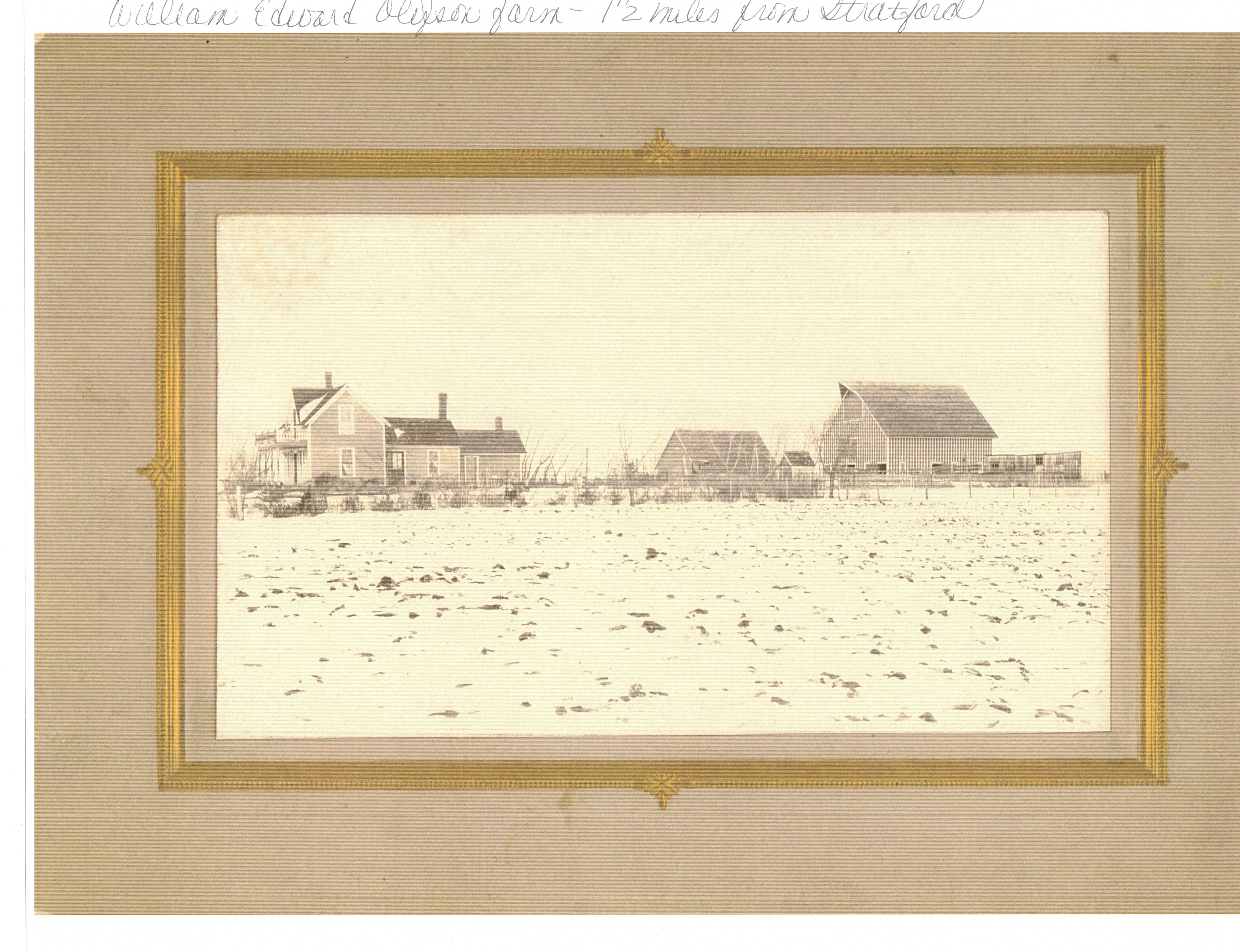
This next picture is a wide view of William Edward Olofson's farm. Many of us have seen a photo of the front of the house, but this view gives us a sense of a much larger house than the one William's father had lived in--with fewer children!


These adorable girls are two of Olof and Brita's children. Bada was born in 1893; her sister Alice was born in 1883. It looks as if this photo may have been taken around 1896.


Bada appears again in the next picture with four of her brothers. Back row: Charles, Gilbert, and Delbert Olofson; front row: Bada and Leon Olofson. Don't all of their little Olofson faces look similar?


This next photo shows the front of William and Olivia Olofson's home, a photo many of us have seen. On the front porch are Maude and Lilly. Also standing on the porch is mother Olivia. I don't recognize the others. Do you?


Below are two photos of the school that Peter, Frank, and Maude all attended. In the top photo, near the right side is Maude, but I don't recognize others.


And finally, two entrees for the Olof Olofson family in the Stratford Evangelical Lutheran church records:


I hope you've enjoyed this look at the homes, schools, and church records for the Olofson ancestors. I'm always looking for additional family photos, so please go to the attic or back of that closet and see what treasures you may find to share.

Monday, September 20, 2021

Linn Photos

To everyone who finds this blog,

I apologize for being absent for a few weeks. Life does have a way of putting some things to the front and pushing others to the back of our lives. But you can see from the photo below, one big piece of news our family is sharing:

On September 9, Penny Belle joined our family and clearly is loved by her two big brothers, Colton and Max. We are overjoyed by this new addition; and you can be sure that she and her brothers will know their family history and learn about their lives that made it possible for all of us to be here to welcome a new life.

In addition to helping with our grandchildren, I've also been spending a great deal of time in front of my computer, going through the thousands of photos and documents that I've inherited from mom, scanning many photos, and adding them to my ancestry.com page. If any of you have an ancestry account, let me know and I'll invite you to be a guest so you can see all of the work I've been doing there.

But I also want to use a couple of these posts to share some of the more interesting photos that I've found and scanned. In this blog, I'll concentrate on Linn photos. Next time around, I'll move to the Olofsons; and after that maybe a look at Lundgrens, Rasks, and others to whom we are related.

Charles Henry Linn was my second great uncle, the youngest child of Gus and Catherine Lundblad Linn. As a young man, Charles and his wife Louise moved to Nebraska where they raised two children, Wallace, and Helen. You may recall the death of Charles was quite unusual. Below is a reminder from the Omaha newspaper:

Omaha Daily Bee, August 19, 1913:

During the severe storm that visited Kansas City Saturday night Charles H. Linn, 2511 Ames avenue, was killed by a lightning shock while using the telephone. The bolt had hit somewhere along the line just at a time when he had the receiver to his ear. He died shortly afterwards. Surviving him besides the widow are two children, Wallace and Helen, both of whom live at home.

Mr. Linn was 46 years of age and conducted a business at Kansas City. His home, however, was in Omaha. 

Isn't Charles a fine looking man, dressed to impress?


Next is a photo of my great uncle Frank Linn, brother of Peter and Elsie Linn. He is holding one of our dear cousins, Joan, who just celebrated another birthday last weekend.

Below is a photo of Julia Linn Berg. Julia was said to have been the first white child born in Webster County, Iowa. The daughter of John Linn and his first wife, Julia was born on January 8, 1851. She married a minister, Rev. Peter Berg, and had two daughters, Edna and Frances.

Julia died in 1905 after an operation for cancer.


I love the photos that show our ancestors as young people, living fun lives. Laughing, dancing, playing instruments, and the following. A photo of Peter Linn with Ken Carlson on the back of a motorcycle in 1913. Wouldn't any of us love to have that motorcycle today?


Cedar Brook farm is where Andrew and Elin Andersson Linn lived and raised their 3 children. Standing outside their front door is Elin, Elsie, Andrew; and in front Frank and Peter Linn.


Between the Linns and Olofsons, there were many cousins for our parents to play with. The picture below shows many of them. I left the handwritten labels on there so you can find those to whom you are related. They are all related to me.

The Linns and Olofsons were musical families. And so were the Lundgrens. Below is a photo that shows Pete Linn on both the mandolin and banjo. Others in the photos, I believe, are Lundgrens.


Do you know the story of how Pete Linn and Floyd Olsen managed to move a very, very heavy rock from the farm south of Dayton to the park near the Dayton elementary school? Read the article below to learn just how difficult it was.


It was dedicated as a memorial rock for local soldiers who served in the Civil War. What a great tribute and one I'm so proud that my grandfather was a major part of.

Our Linns must have been very, very social. I have so many photos of parties, dances, card playing, and more. Sadly, most are unlabeled. But my last photo for this post is one that was labeled. I've kept the labels so you, too, can recognize some of the important members of our family.


I hope you enjoyed this look at some of our ancestors and their daily activities. While this is a huge job for me that will take years, I'm enjoying learning more about my ancestors and scanning as many photos as I can.

Next week: the Olofsons


Sunday, December 16, 2018

Through Bessie's Eyes

Gus and Catherine Linn had 7 children, 3 girls and 4 boys. Two of the girls died at a young age, leaving Mary Linn as the only surviving girl with 4 brothers (John, William, Andrew, and Charley).

In 1887, when Mary was 24, she married Milan Curtis. The couple lived in Dayton where Milan worked in an egg house.

Mary was good friends with Henry (aka Harry) and Elsie Meanor Kinney, who had 6 children. Sadly, Elsie died shortly after the birth of her youngest child. Harry was unable to take care of all of the children. Some were adopted by local couples and two stayed with Harry's parents. The 5th child, Bessie, at just 18 months of age, was adopted by Milan and Mary Linn Curtis who were unable to have children of their own.

Elsie Kinney Obituary


Several years ago, I corresponded with the granddaughter of Bessie and received a remarkable 36-page autobiography written by Bessie in 1976, just 3 years before her death. Today, I'd like to share a small part of it with you because Bessie writes about her early years in Dayton and describes some of her uncles and aunts, the Linns, to the reader.

I was born December 14, 1895, in Fort Dodge, Iowa. My parents were Harry and Elsie Kinney. When I was 18 months old, my mother died. There were six children in our family, and I was next to the youngest. After my mother's death, I was adopted by Milan and Mary Curtis. They lived in Dayton, Iowa. My grandfather and grandmother Kinney also lived in Dayton. Mama and Papa Curtis were old friends of my parents. My brothers and sisters were Flossie, Dorsey, Georgia, Nellie, and Percy.
I was raised as an only child and given much love....When my mother first brought me home, she sent me to meet my father. When she saw him coming, she said "go meet papa". So I toddled down the path and when I met him I said "papa". That was all it took. He was my slave from then on!
Mama Curtis had three brothers that lived on farms near Dayton. Mama's parents [Gus and Catherine Linn] had been born in Sweden, and two of her brothers married Swedish wives. [Note: That would be John and Andrew.] I used to love to go to their places. Our Uncle John had a large house and a great big barn, at least it looked so to me. Aunt Maria [John's wife] used to make Ostakaka, or Swedish pudding, that I was crazy about. When I got old enough to have a bicycle, I would ride to their place once in awhile. It was six miles from town.
The thing I remember about Uncle Bill's place [William Peter Linn] was the fried chicken, cream gravy and home made ice cream that was out of this world. They had a big refrigerator and I loved to look in there and see the big crocks of milk. Uncle Bill had five children, and Ivy, the girl, was just about my age....My folks always kept a horse and buggy so went to each of the three places quite often.
Uncle Andrew and Aunt Ellen [our Andrew and Elin Linn] lived over near Stratford. In the spring I could hardly wait for school to be out so I could go over to Uncle Andrew's. They had three children, all near my age [Elsie, Peter, and Frank], and when I went over there, their school wouldn't be out yet and I went with them. It was fun to carry my lunch in a bucket and then, when their school closed, the teacher always had me take part in the program.... Another thing I loved to do over there was to pick June berries. One day Aunt Ellen and I walked over through the field to call on one of her neighbors. We picked wild strawberries on the way.... Frank, their youngest boy, was about my age. We liked to find pretty chicken feathers. We would ... [pretend] horses and played all kinds of games.
There was a nice creek that flowed past our town and in the winter the townspeople would put in a dam so as to form an ice pond. That was before the days of the electric refrigerator, so a good many people put up their own ice. My father, being in the produce business, had two large ice houses because he used ice to ice the box cars that he shipped butter and eggs to Chicago.  
When my folks went over to Uncle Andrew's in the fall of the year, we would go to the river road. Someone had a little run-down looking store, which we called Hard Scrabble. On that road there was alot of hazel nut brush and we would gather those. 
One of the outstanding events in the summer was the Fourth of July celebration. They had a big park south of town where they had a parade and marched and gave speeches. As I remember it, someone always gave the Gettysburg Address. Dayton had a good band, so we had lots of music. 
NOTE: Milan Curtis became very ill and had 55 gallstones removed at the Mayo in Minnesota. While recuperating, he and Mary took a trip into Canada and the Western United States. Following is Bessie's recollections about their move from Iowa to Idaho.
Dad had fallen in love with Idaho, so when they came home, he sold his business, sold the house, and sold some furniture and shipped the rest to Payette, Idaho. We came out by train. [NOTE: Bessie was 15 and a junior in high school.]
The rest of her autobiography is about their time in Idaho and Oregon, with portions adopted from the granddaughter's interview of Bessie:
Bessie married twice, had 3 children. Bessie and her first husband separated when the youngest, Betty, was just about 5. Bessie sent one son to live with an Aunt in California, another son to live with Mary and Milan Curtis, and the daughter Betty to the State Home for Children. This was so that Bessie could go to business school and learn a skill to support her and her children.
Grandma Mary Curtis went to visit Betty in the State Home after she had been there several weeks. She found Betty crying in the corner and not liking how Betty was being treated insisted that Bessie remove her from there. She was only there two to three months. She then stayed with Grandma and Grandpa Curtis [Milan and Mary] until her mother finished school.

Bessie Kinney Curtis

Bessie died in 1979 of leukemia and is buried in Idaho.

Isn't this a wonderful snapshot of the late 1800's and early 1900's in the Dayton area? A peak at how loving Milan and Mary Linn Curtis were, not only with their adopted daughter Bessie, but also with their granddaughter in taking her out of the Home for Children? And a lovely look at our direct-line ancestors, John, William (Bill) and Andrew Linn, as well as a special mention about Frank Linn.

Our ancestors didn't write much that gives us clues about how they lived their lives. But what a gift, in this case, to learn about them from a life sketch written and shared by Bessie. If you have a diary, a journal, a letter, or any other document that shows something about the day-to-day lives of our ancestors, will you please share it? Scan or copy it so we can all learn and appreciate the lives our ancestors lived.


 .


Sunday, November 25, 2018

Family Photos

With just a few weeks to go before the end of my 52 ancestors in 52 weeks blog, I want to be sure that I share a few photos. Some readers may have these; others may not. But they are an important part of our family history.


Andrew and Elin Anderson Linn; married November 1, 1888


Cedar Brook Farm, home of Andrew and Elin Linn and their 3 children: Elsie (1889), Peter (1892), Frank (1895)
 photo around 1903-1906?


Aerial view of the farm Peter and Maude and their sons lived on, later the farm our family lived on. This was taken around 1950. Long walk from the house to the outhouse!

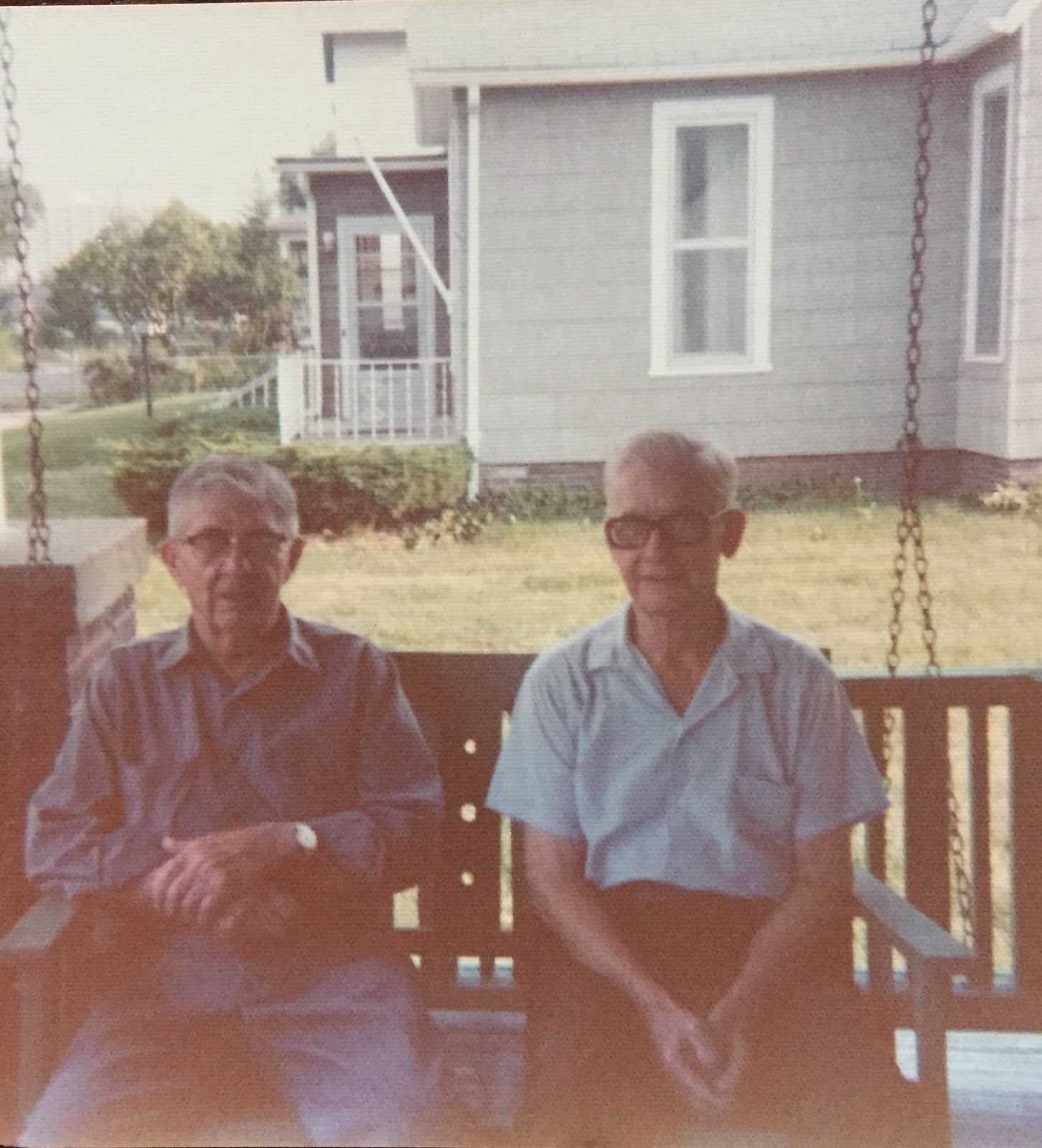
This is one of my favorite pictures of our beloved Peter and Frank Linn, brothers sitting on the front porch swing in Des Moines, 1979.


My dear grandparents, Peter Edward Linn and Maude Edith Olofson Linn.


And on the Olofson side: Olivia Rask Olofson, my great-grandmother, died in 1943. Below is the sale of her farm shortly after her death:

You can see the total price, followed by expenses and the distribution to her 3 children.


And below is a copy of Olivia's Last Will and Testament, a very simple one, leaving everything divided among her 3 children:

 At the time Olivia wrote this, she states that she is 62 years old, meaning it would have been written in 1921. Yet, the date is 1924, about 8 months after her husband's passing. It's clear that Olivia is still holding on to the belief/story that she was born in 1862, not 1859. We all know better and have the proof in her birth record and Swedish clerical surveys.


William Edward Olofson and Olivia Rask wedding photo, 1889

In a previous post, I placed a portion of the Linn and Lundblad ancestors in a chart. Following is an Olofson/Barquist tree:


The two Olof Rasks is not an error. Father and son had the same name.

I've traced our ancestors in all of these lines several more generations, but I hope this helps put many of our ancestors into a visual for you.

I'll keep looking through old family photos and post some interesting ones before the end of the year. Do you have one you'd like to share? If so, please send it and I'll make sure it's posted for others to enjoy.

Sunday, July 15, 2018

Peter and Frank Linn - In Europe During World War I

From the last post, we know that Frank and Peter were drafted, received their basic training at Camp Dodge, and were assigned to different units before leaving for Europe.

On July 31, 1918, Peter’s unit left by train for Upton, New York, where they arrived on August 2 for an August 9 departure to Europe. What would these young, single soldiers do on their time off in New York? What would a young Peter Linn do? It is the stories he told of that time, like the ones below, that show a picture of the man and the soldier.

Peter, my grandfather, was a fun-loving man with a great cackle for a laugh. While I never heard these stories directly from him, I can just imagine him telling them, like the one below, to an adoring grandson, Myron, who shares here:

When he was in New York City on his last night before catching the ship to Europe, Peter and another soldier were out having one last night in port and looking to do some partying. They weren’t permitted to buy liquor without a New York license, so they found a ‘bum’ on the street and offered him $5 to buy a bottle of whiskey. While they were waiting outside the store, another ‘bum’ came along and called the first ‘bum’ by the name of “Slim”.

Soon the ‘bum’ came out of the store, gave the two soldiers the full bottle, and told them not to open it until he was gone because it was against the law to buy for someone else. The two soldiers waited until the ‘bum’ was gone, then opened the bottle, and found that it was diluted coffee. They spent the rest of the night looking for the ‘bum’. They saw the second ‘bum’ and asked where they could find “Slim”. That ‘bum’ turned to them and said, “Hi Slim.” He called EVERYBODY “Slim” whether he knew them or not!

Once he was in France, Peter tells another story (recalled from Myron):

On a quiet night with the wind blowing toward the Ally trenches, he could hear the German soldiers talking. With the enemy so close it developed high levels of stress and quick reaction to anything that looked like a potential attack from the Germans.

During the late evenings, the men took turns in duty assignments to be "on watch" while most of the soldiers slept. Only a few were awake and watching for an enemy attack. That made it even more stressful as the entire regiment was relying upon the soldiers who were on watch.

As one of the newest men assigned to his regiment, Pvt. Peter Linn was assigned to be on watch and to respond to anything that might signal an attack from the Germans. Front guards were positioned out front of the trench line, typically at least 30 yards or so, and sometimes more. In order to allow "friendly" soldiers to move to and from the outpost positions, there was a password that was used. If you knew the password, you were allowed to pass, but if a person did not say the password when challenged, it was assumed that the person was not friendly and had to be neutralized.

On this particular night, Pvt. Peter Linn was assigned to an outpost in the dark of night with only a dull moon providing any light. He had not been in this position before, so he was not familiar with the terrain.

Soon after he took his position, in the dull moonlight, he saw a man standing in front of him by several yards. It was dark with only very dim light, and Peter was going to do his duty.

Pvt. Linn raised his rifle and told the man to give the password. There was no response. The man stood still and gave no reply. Pvt. Linn demanded the password, and again the unknown person stood still and gave no response. "This is your last chance--give the password!" No response; just standing there in the very dim light of the moon.

Pvt. Linn did his duty. He shot at the man from his outpost position, and ran back to the trenches where everyone now was awake and aiming their rifles to the oncoming attack. It started out slowly, with a few bullets form each side, but it escalated into an exchange of heavy fire. Within a short period of time, the exchange subsided, and the attack had been repulsed. Pvt. Linn had done his duty in his outpost assignment and had protected his regiment.

Except..., at the break of dawn the next morning, Pvt. Linn looked out to see if the man he had shot at was in front of the outpost. What he saw was not what he expected. In front of him, instead of a wounded or dead German, there was a stationary tree. About 6 feet tall, with only a few leaves, but with debris hanging on its branches. That "man" that he had shot at, which started several minutes of exchange of fire with the enemy, was ONLY a tree.

Grandpa never told anyone that he had mistaken a tree for an enemy soldier. But 60 years later, he shared this story with Myron.

I love this story about the humanity of Grandpa Linn, showing his young, vulnerable side but also his determination to do his duty and to protect the other soldiers who relied on him. Funny, too, but shows how very stressful this time was.

Peter Edward Linn, handsome World War I Private

I have one copy of a photograph of Frank, in which we see that Linn face and a very handsome Private Frank Linn:

Frank Linn, handsome World War I Private

Exactly where Pete was, what battles he was involved in, I would refer the readers to several articles or books or a google of his unit. There are many articles about the 88th Division, about the 349th Infantry. Here are just a couple for my readers to review:

History of the 88th Division

From Wikipedia, the following about the 349th: The 349th saw minor combat in Alsace just before the war ended, and the 88th Division as a whole suffered only 78 total casualties. The 349th was deactivated on June 12, 1919, at Camp Dodge, Iowa, the same place it was organized.

One story we learned from Peter is how heavy the gear was that each man was responsible for. According to The 88th Division in the World War of 1914-1918, page 16, during September 23 - November 1, 1918, in order to reach the Center Sector of Haute-Alsace, the men were "forced to make long marches--sometimes 25 km a day--on congested roads, pulling with them their heavily loaded machine gun carts, combat and field wagons, in cases the average weight pulled per man being 250 pounds." It's no wonder that many soldiers jettisoned items from their own backpacks. What would a soldier be willing to give up? What did he think would be necessary to keep him safe? In Peter's case, unlike that of many other soldiers, he kept his gas mask. And several years later, he told family members that he was certain the gas mask had saved his life.

Long, narrow trenches often dug by the soldiers who would occupy them, were used widely in France during World War I. While trenches offered a bit of cover and time to prepare to battle or to put on a gas mask,  they also were unsanitary. Water and mud up to the calves caused trench foot and, in some cases, amputations. Dysentery, influenza and other diseases spread quickly. Soldiers like Peter and Frank might have spent weeks in a trench, not far from their German foes.

Because so much equipment was tossed along the way to lighten loads AND supplies such as food were not available, often the soldiers had hard tack and cheese alone for their meals. One might expect that the rats that also lived in the trenches and fed on the corpses would look enticing. And, according to Peter, they were. He tells of luring the rats near the trenches where they were killed and then eaten.

Another story Peter told was how he had stood at the intersection of 3 countries while he was in Europe during World War I. While the maps have changed, boundaries have moved, it appears that he would have stood at the intersection of France, Germany, and Switzerland.

Sadly, I don't have any stories that Frank told of his service in Europe, but I would imagine that he would have had similar stories to tell. (Well, except for that shooting the tree incident!) Frank was assigned to backfill the 163rd Infantry, Company C, 41st Division. And because the nature of this "casual unit" was to fill in where needed, I would refer the reader to articles or books about the 41st Division and/or the 163rd Infantry.

The final post on these two brave soldiers will be about their trip home. In both Peter's and Frank's situations, the trip back to Iowa was not an easy one.

Peter and Frank - Coming Home

Grandpa Peter Linn spent about 9 months in Europe, most of it in France, during World War I. And his brother Frank Linn spent 5 months in Europe. Thankfully, it was time for them to come home.

Peter Linn left St. Naizaire France on May 19, 1919, on the Ryndam which landed in Hoboken, New Jersey. After that, the soldiers were assigned to Camp Merritt. Peter was discharged on August 4, 1919. Back to Iowa, back to his parents and farming, and back to his girlfriend, soon to be wife, Maude Edith Olofson, but not as easy as it seems. At the end of this story, you will see what made Peter's return anything but easy.

Line 110, Peter Linn on Ryndam, landing in Hoboken and then to Camp Merritt


Frank's journey home was a bit different. His unit was scheduled to leave from Brest, France on February 13, 1919, to Hoboken and then to Camp Dix, but you can see from the transport list below that Frank's name is crossed off the list of soldiers with the following notation: Sent to Camp Hospital #33 in France, January 31, 1919. And so, while the rest of his unit sailed home, Frank was in the hospital. I don't know why, but my guess is that it was influenza which was rampant at that time among soldiers. What was Camp Hospital #33?

The hospital was located at Camp Pontanezen at Brest, France, which was a staging ground for soldiers returning to the United States. This is what I've learned about the hospital:


Camp Hospital No. 33 was established January 15, 1918, at Camp Pontanezen, Department Finistere, base section No. 5, by a detachment of 5 medical officers and 40 enlisted men. When first opened, the hospital was located in an old French concrete building, which formerly had been used as barracks. Many difficulties were experienced at this time in the care of the sick, as hospital supplies were very difficult to obtain. Medical equipment consisted of the contents of medical and surgical chests. Except for candles, there were no lighting facilities. On February 1, 1918, in addition to the old stone barracks then occupied by the hospital, a fairly modern three-story, fireproof building was taken over. Later, when increased hospital facilities were necessary, 8 Adrian-type barracks were erected, to accommodate 35 patients each, and four 300-foot barracks. Twenty-four additional wards, kitchens, supply rooms, dispensary, officers' and nurses' quarters were constructed in this area. Also, large huts were erected both on the inside and outside areas by the American Red Cross.

Camp Hospital No. 33 served the entire port of Brest. Although it treated more patients than did the majority of the base hospitals in France and served the largest camp in the American Expeditionary Forces, it never was rated as a base hospital.

Due to the absence of any sewerage system and to the climatic conditions, the problem of sanitation was a serious one and became more complicated as the number of patients in hospital increased. Latrines of the can type were used, the cans being emptied by French contractors, who proved to be very unsatisfactory. The difficulty in rendering these latrines flyproof and sanitary was practically insurmountable; the use of an incineration plant was impracticable, due to the scarcity of wood and straw.

During the period from January 15, 1918, to June 30, 1919, this institution admitted 28,233 medical and surgical cases. The majority of its patients were medical, which up to June 30, 1919, included 4,814 cases of mumps, 3,521 of influenza, and 2,205 of pneumonia. [Note: These 3 diseases added up to 10,540 of the patients or 1/3 of those who were in the hospital during the time Frank would have been treated there.]

Based on the "History, Camp Hospital No. 33, A. E. F., Camp Pontanezen, by the commanding officer of that hospital. The history is on file in the Historical Division, S. G. O., Washington, D.C.


Frank wasn't in the hospital long as he sailed to New York on March 1. 1919. From there, he was sent to Camp Merritt where he was discharged. 


Frank Linn was not on this ship and was placed in Camp Hospital #33. Line #122.

Frank was placed on a ship bound for New York and then to Camp Merritt where he was released on March 14, 1919:

Frank is listed first, on line #15 traveling with another unit.
Everyone was happy to have these two local boys home again. Frank's name appeared in the Dayton Review, March 20, 1919, page 9:

It appears that Frank's short stay in the hospital made all the difference in his health.
Grandpa Peter Linn's story of coming home is a bit different. We all know that he had severe stomach ulcers his entire adult life, which probably started with his time in France. The following article from the Stratford Courier, August 21, 1919, page 1, shows how he struggled with his health as he came home from the war:


As descendants of these two men, we are so very proud of their service to our country in World War I. I hope that I've done them and their service justice. My apologies to my readers who understand military history and terms better than I do. If you find an error or feel as if something needs clarification, please comment on the blog for others to see. 


Sunday, July 8, 2018

Peter and Frank Linn - World War I Service

We have many military ancestors in our family, dating back to the early 1700's in Sweden. Recently, one reader asked about stories of Peter and Gus and their service, but today I'm going to start with a look at two ancestors that we all know: Peter Linn and his brother Frank Linn.

In 1973, a fire burned over 80% of the World War I soldiers' records in St. Louis. Without all of those details, we are left to piece together from the remaining records and stories we have been told, the experiences of both Frank and Peter Linn. Burnt in Memory: About the 1973 Fire

Those of us who descend from Peter know a great deal about his war experiences. Stories were told to family members. We always knew in what unit he served. In future posts I will include some stories about his service in World War I, but today we begin at the beginning with his draft card:

Peter Linn's World War I Draft Card, dated June 5, 1917
His brother Frank Linn also served in World War I; and, although less is known about Frank's war experience, I'm excited about what I did find out that I'll share in these posts, starting with this draft card, dated the same day as his brother's:

Frank Linn's World War I Draft Card, dated June 5, 1917

Peter reported for basic training at Camp Dodge in May of 1918. Frank reported sometime in July 1918. Camp Dodge was the home of the 88th division, also known as a "draft division" meaning that both Peter and Frank would have been drafted into service. These two young Iowa farm boys were part of a famous photograph taken at Camp Dodge, known as the "human Statue of Liberty," formed by 18,000 posed soldiers as part of a promotional campaign to sell war bonds during World War I. The photo, however, was never used. Can you spot either Peter or Frank below? No one in our family ever thought to ask them where they stood. But my understanding is that several soldiers fainted while standing in their wool uniforms on that hot and humid Iowa July day.


Take a look at other photographs from Camp Dodge, courtesy of the Des Moines Register. Camp Dodge Photos

Peter was assigned to Company E, 349th Infantry, of the 88th Division, and on August 9, 1918, he shipped off for Europe aboard the Olympic. (Line 135 on the following army transport service list.) The ship that Peter sailed on, the Olympic, interestingly, was the sister ship to the Titanic. Much has been written about this ship and its involvement as a troop transport in World War I.


Peter Linn, Serial #3226704, Andrew Linn is emergency contact

Peter's assignment was straight forward. He was assigned to a specific company in a specific infantry and division and stayed with that group of soldiers for the duration of his service. However, Frank's assignment was a bit different. After completing his basic training at Camp Dodge, Frank was assigned to what was known as a "casual unit", sent to Camp Gordon, where he was assigned to the August Automatic Replacement Draft (AARD), Company 25 Infantry. The men assigned to this unit were used as backfill to existing units in France. Frank shipped out on September 1, 1918, on the Belgic and, once overseas, was assigned to Company C, 163rd Infantry, 41st Division. Frank's entry is on line #145 on the following army transport service list.

Frank Linn, Serial #4004152, Andrew Linn is emergency contact
This information gets our two ancestors to Europe. Before we look into their activities in Europe, there is one more story about their time at Camp Dodge to share in the next post.

A Hanging at Camp Dodge

Several years ago I learned about the hanging of 3 black men at Camp Dodge near Des Moines, Iowa, when thousands of soldiers were going through basic training for World War I. Through a bit of research, help from Myron, and a letter to Camp Dodge, I learned that my grandfather, Peter Linn, and his brother, Frank Linn, were witnesses to the hanging.

I wrote the following then as part of a story about Grandpa, but my readers who are descended from Frank Linn will undoubtedly find this interesting, and troubling, as well.

THE HANGING AT CAMP DODGE

They were in trenches, just about 100 yards from each other. The German soldiers on one side, the U.S. soldiers on the other. Late at night, they could hear the roar of the fighter airplanes overhead, Red Baron types chasing each other through the night sky. Whenever a German plane was shot down and German airmen died, one could hear the cheers from the U.S. trenches. And when a United States airplane was shot down and U.S. airmen aboard died, a tremendous cheer would rise from the German trenches.

In one of those trenches was my grandfather, Peter Linn, a private in Company E, 349th Infantry, 88th Division of the United States Army, stationed in the Alsace region of France in November 1918. He was part of the cheering when German planes went down; he was part of the despair when he realized that U.S. soldiers had died. Peter knew that the U.S. soldiers who had been shot down were heroes, would have a hero’s burial, and would be written about in their hometown newspapers as heroes of fighting the Germans in World War I.

But in that trench on a cold November evening, Peter also reflected on other soldiers’ deaths, those deaths that took place on July 5, 1918, at Camp Dodge, just outside of Des Moines, Iowa. Camp Dodge was a major basic training post in the United States. In 1917, a “city” of nearly 40,000 rose almost overnight and was the army encampment for thousands of Midwesterners who were going through basic training and then to Europe to fight.

Peter had arrived for basic training in early May, 1918. It was his first time, as a 25-year old man, to be away from home, off the Iowa farm he worked with his father, and the first time away from his girlfriend, Maude Olofson.

On May 24, 1918, just a few days after Peter arrived for basic training, a 17-year old white girl was allegedly raped at Camp Dodge; and four black soldiers were quickly arrested. In separate military trials, three of the soldiers were found guilty of the rape and sentenced to hang. Both President Wilson and Newton Baker, the Secretary of War, upheld the verdicts.

On the 5th of July, the entire camp, nearly 30,000 soldiers, was ordered to come to the quickly constructed gallows to watch the hangings. It was a muggy, humid summer evening around 9 p.m. The 3,000 black soldiers in camp were led from their segregated bunkhouses and forced to stand closest to the platform as a reminder of what happens to black soldiers who get out of line. In addition to the entire division, hundreds of curious onlookers, mostly civilians from Des Moines, watched the spectacle. It looked like an amphitheater with gallows in the center and soldiers tiered on every side. With no wind, every sound, every noise carried to the far reaches of the amphitheater setting.

Peter was on a hill, nearly 50 yards away but still close enough to hear and to see the proceedings. Word spread among his fellow soldiers that the three men were really innocent of the rape. How could this be happening? Were these fellow soldiers innocent? Could they have been guilty of such a dreadful crime? This 25-year old Iowa farm boy private could only watch in some kind of shock and disbelief. He saw the three men being led slowly to the gallows; saw two of the young, black soldiers walk silently, heads bowed. But the third man was wailing, and as they marched closer and closer to the gallows, his wails grew even louder. It was guttural, wailing from the soul, wailing that everyone in the camp could hear.

Peter watched with a mixture of curiosity and confusion as the nooses were slipped over each of the three men’s necks and then tightened. These 30,000 young, inexperienced soldiers, just ordinary young men, mostly farmers, were watching the most horrendous site they had ever seen. The three condemned men stood with hands tied behind their backs, heads lowered, moaning and wailing.  Most of the soldiers in camp had to turn away.

Three ropes fell from the platform to the rear of the scaffold. Only one of the ropes activated all three traps—two were dummies—and only Captain Harry Baker knew for sure which rope was alive. Three of Baker’s enlisted military policemen stood with upraised axes and upon command simultaneously cut the ropes.

This was the only execution in the state of Iowa carried out for a non-murder charge. For many of the men, including Peter, it was said to be worse than anything they ever saw in battle.
And on this night in France in a muddy trench, Peter reflected on that painful July night, just 4 months earlier. Three young black soldiers, guilty or innocent? Given a fair trial or not? Victims of racial discrimination or guilty of the rape of a 17-year old white girl? These three young men would not be seen as heroes of the war, would not be written up in their hometown newspapers as anything other than guilty of rape and dead by hanging at Camp Dodge. My grandfather Peter carried this picture, this story, those memories, with him his entire life.

For more information on the hanging, read Wartime Illusions and Disillusionment

Next week we will look at the lighter side of Grandpa's wartime experience. If you have stories to share, please email me and I'll include them.