My ancestors came from both Sweden and Bohemia, settling in Iowa. Through this blog I hope to share information with my own relatives about my Swedish ancestors. Please comment or share any interesting and relevant information you have on this family line.

Sunday, October 10, 2021

FROM GOTHENBURG, SWEDEN TO BOONE COUNTY, IOWA

We've read about the difficulties that John Linn and his wife Brita Eriksdotter had in 1849 gaining permission to leave, making the trip to the port, and waiting for their turn to finally board the ship to North America. Today is Daniel Peterson's final pages that, I think, are the most compelling. We learn about the actual trip across the ocean and then all of the twists and turns, diseases and deaths, to finally make it to their destination.


This is a very detailed description of what Daniel saw and experienced and for that I'm so thankful. But as we continue to follow this group from the shore to their destination, it can be difficult to follow. At the end of this narrative, I've placed a map showing the route they took to make it a bit easier to see.


FOUR MONTHS AND 14 DAYS!

Library of Congress maps: https://www.loc.gov/resource/g3700.fi000230/ for the 1850 map which I used to create the following:


Each of the orange triangles represents a stop in Daniel's story. 
  • Sandy Hook, a barrier spit in Monmouth County, NJ; Health officer came on board. Towed up to Castle Gardens which was simply a port until 1855 when it was established to help with translations, letter writing, quarantines and more;
  • Steamer up the Hudson River to Albany, NY
  • Canal boat through the Erie Canal to Buffalo, NY
  • Lake Steamer bound for Chicago which took 5 days; Notice the long way around through the lakes because no railroads were there at the time for a more direct route
  • Boat on the Michigan and Illinois River canal to Peru, IL.
  • Steamship to St. Louis where they experienced severe cholera.
  • Boat captain took them up the Mississippi River to Keokuk, Iowa
  • Teams and teamsters took them to Des Moines (Raccoon Forks) by canoe.
  • Teamsters took them by land to Boone County.
I'm exhausted! And I'm in awe of our immigrant ancestors for their decisions, their courage, their will to make this journey. And I'm so very, very thankful. 

I hope you've enjoyed this narrative, too. And any of our ancestors who came during that same time period would have experienced similar routes and challenges.


Thursday, October 7, 2021

ANSWERING A COUPLE OF QUESTIONS

Thanks for the comments and questions about the first two parts of John Linn's journey. I was so excited to read this story, and so very happy to know you're enjoying it as well.

One person asked if seeing a photo of Dodringshult, the farm in Jonkoping where John, Peter, and Gus lived for a time until their father died, would help those who are new to this genealogy journey. On 28 January 2018, I did post about their father Olaus Fredericsson and included a couple of photos of the beautiful farm on which they lived. We visited there a few years ago. It's expansive. Green. Beautifully maintained. You can see the photos by going back to that earlier post. And I would encourage you to go back to read any of the posts that might give you more of the story about the individuals currently at the center of these posts.

We know, of course, that none of the three brothers left from Dodringshult for North America. They each went to work on farms as soon as they were able, moving from time to time to find work as a laborer or drang. John was on a farm called Packarp in Ulrika Parish, Ostergotland County when he joined up with Andrew Peterson and the others traveling in 1849.

Peter was working on Svarvarestugan in Ulrika Parish when he left in 1851. And Gus also left from the same farm and parish. 

These 3 brothers had moved around a great deal, but I imagine they may have felt that Dodringshult was their home, a place where their family was in tact and happy until 1830.

A second question came up about the author, Daniel Peterson, who was just 10 years old when the journey was made. The Petersons are not related to us as far as I can determine. But they did settle near our Linns and undoubtedly remained friends, retelling the story they all shared in migrating from Sweden to Iowa. Daniel was 39-40 years old when he recounted the story we are reading, but it appears from the records I've found that Daniels parents, Andrew and Maria were also alive in 1879 and 1880, perhaps helping him fill in any details he may have forgotten.

Daniel died in 1927 and is buried in the Linn Cemetery in Pilot Mound.

Monday, October 4, 2021

PART TWO IN JOHN LINN’S MIGRATION

I hope you enjoyed reading the first part of the migration to the United States of 37 Swedes, including the Peterson family, along with John Linn and Brita Eriksdotter. The difficulties they had in obtaining the necessary approvals, the warnings and threats they received from family and friends, and the sad goodbyes to those they loved and to their home country, had to be difficult for every one of our ancestors.

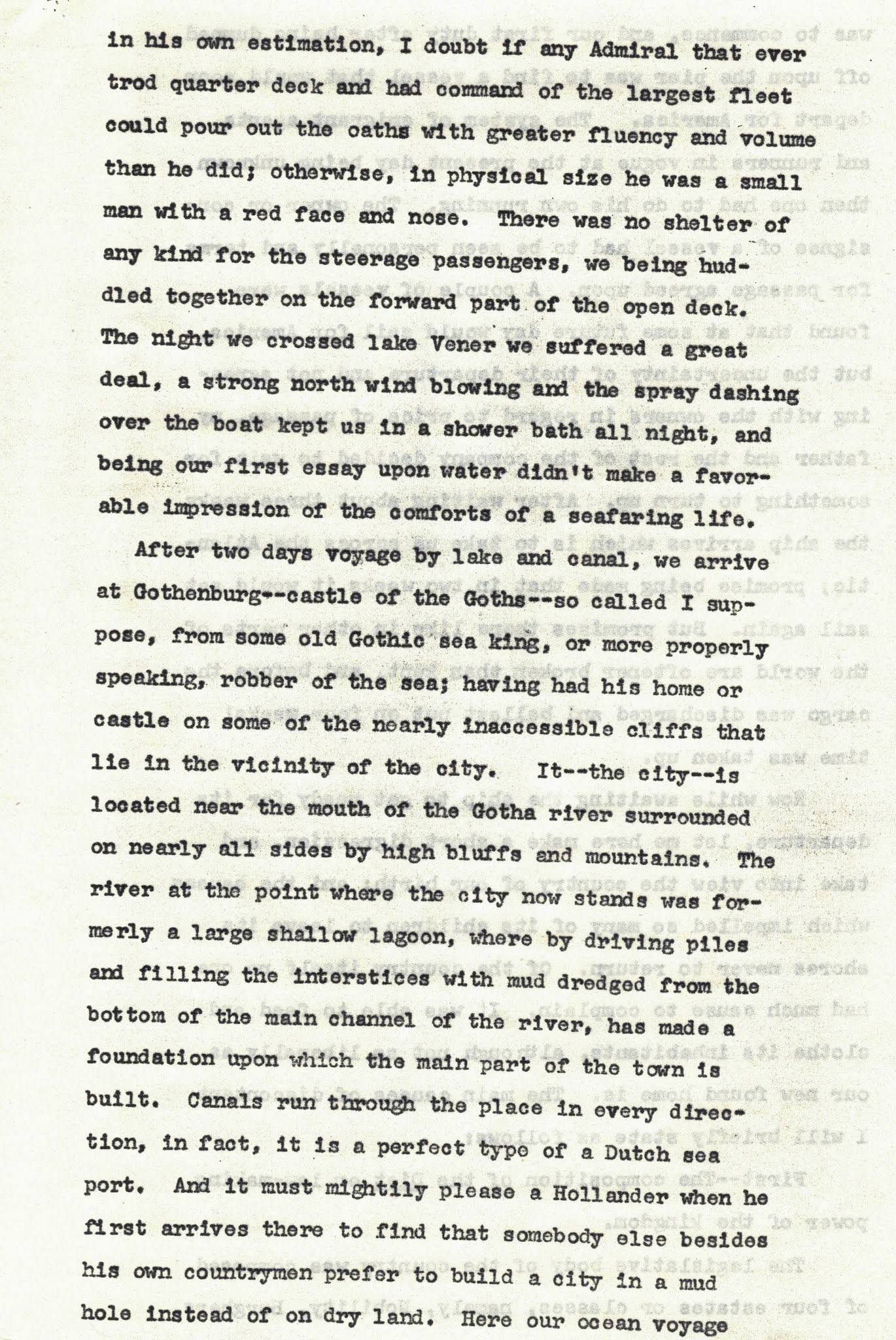
In this installment written by Daniel Peterson several years after the migration, we learn about how these Swedes made their way to Motala, a destination where they would wait for transportation over the series of canals and rivers that would take them to the port of Gothenburg where they hoped to find a boat that would take them across the ocean.

This installment will take our group to the port of Gothenburg where the writer describes the various reasons why the Swedes were eager to leave for a new country.

John and Brita were the first two on the Linn ancestral line to migrate. But those of us who also are related to the Olofson line know that the Olofsons came in 1850 from northern Sweden to Wisconsin, probably following some of the same routes.

Enjoy reading Part 2. And please send any questions or comments to me through the blog: ancestorfootprints.blogspot.com


Already, it has taken this group of travelers 3-4 days just to move from Ulrika Parish to Motala to wait for a steamer to take them to Gothenberg. While waiting even longer in Gothenburg for passage across the ocean, the writer tells us of the reasons his family and others decided to make the difficult decision to leave Sweden. He gives us four reasons, each having merit; but it's #3 and #4 that have always held the most truth for me.


Our travelers are ready to set sail on the Virginia for the new world. What would they find there? How would they make their way to Iowa? The final post for this incredible adventure will be up in a few days. I hope you're enjoying this very detailed description of their travels, but I've definitely saved the best part for last. 


Thursday, September 30, 2021

AROUND HALF THE WORLD IN SIX MONTHS

Several family members have asked how our ancestors traveled to the United States. Ship the entire way? Train? Walking? Covered Wagon? And what route would they have taken? I have to say that I’ve been equally curious about this and, until now, simply had a reasonable guess based on migration patterns of the time.

But now I know for certain how at least one of our ancestors came from Sweden to Iowa. An exciting find that I’m thrilled to share with you.

John Linn and his wife Brita Eriksdotter left Ulrika Parish in Ostergotland County on 25 April 1849. John and his wife appear on the ship manifest for the Virginia and arrived in New York on 24 August 1849, a trip across the ocean that took FOUR months. But that was not the end of their migration. And certainly there was a story to tell about the entire trip. But until now, I couldn’t fill in the blanks.

While going through one of my mom’s 3-ring notebooks, I came across a 35-page typewritten narrative written in 1879 and 1880 by another passenger who made the same trip with John and Brita. It’s wonderfully written with details to bring the trip alive for the reader. There is no way that I could summarize this narrative and do it any kind of justice; and so, I’m going to post it in parts that won’t be too long to read at one setting and will keep you intrigued to learn what happened next in their trip.

The narrative was written by Daniel Peterson who was 10 years old at the time of the emigration. He was the son of Anders Peterson and Maria Hansdotter, also of Ulrika Parish in Ostergotland County. While I cannot determine how John’s and Anders’ paths crossed, the farms they were on were in close proximity and they undoubtedly would have attended the same church. Family story tells us that Anders paid for John and his wife to come to America and we learn in the narrative that John worked for Anders, building his home, which lends support to John’s paying off a debt.

Because the narrative was published in a newspaper, I am assuming that my posting it for our family and friends to read would be of no concern.

Enjoy the first installment:


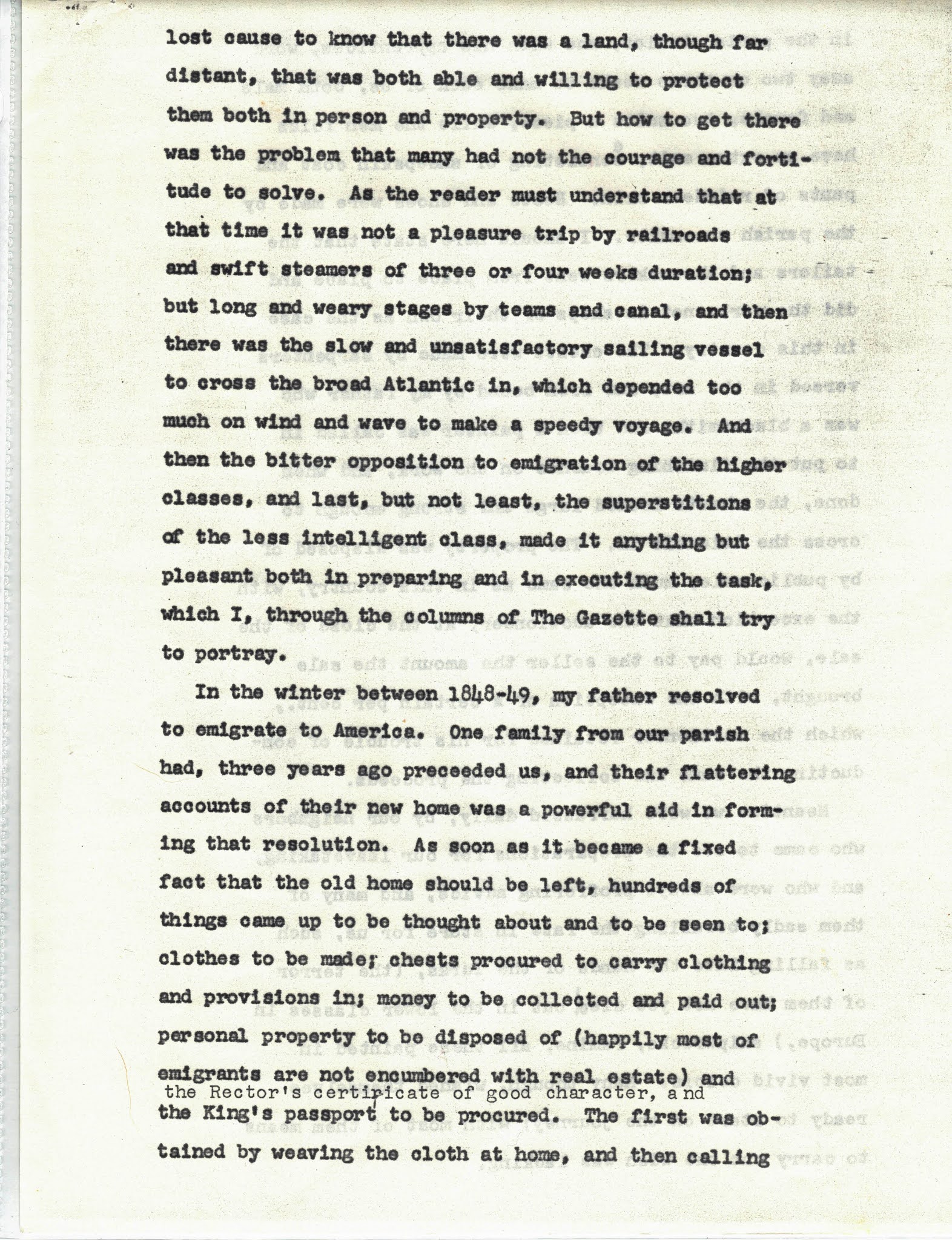
What an incredibly detailed process it was to receive the proper papers to leave Sweden. Being harassed by neighbors and friends, hearing tales of how doomed their lives would be if they crossed the ocean, and the expense of all of this...It's difficult to imagine our ancestors going through all of this to make their way to the new world. And there's more for them to face:


The work that had to be done, the harassment and warnings they received, clearly show in Daniel Peterson's writing. And remember that John Olausson Linn and his wife Brita Eriksdotter were going through the very same formalities and warnings. Next week we will learn about how they traveled to the port where they would sail for America. Just the beginning of an amazing trip to Iowa. And whether you are related directly to John Linn or not, this same process was waiting for the Olofsons and Rasks and Lundgrens and more of our ancestors. And given that Peter Linn came a year later and Gus two years later, I think it's reasonable to assume that their adventure was much the same as well.

If you are unable to enlarge the pages for your reading, please let me know. I can send a couple at a time through email. It's worth taking the time to read. A great find hidden in mom's notebooks.


Tuesday, September 28, 2021

OLOFSON PHOTOS

 I have so many photos of the Olofson family. From my great-great grandfather Olof and his second wife and family to William Olofson, his wife Olivia, and their children, and more. Today, I'll pick a few that I'm not sure I've shared before. I hope there are some new ones in here for you to enjoy.

Olof Olofson married Brita Rask in 1880 and together they raised William who was the son of Olof, Anna Sophia Charlotta who was the daughter of Brita, and the 7 children they had together. Below is a picture of this handsome group:


Taken around 1904, they are (back row) Charlie, Lottie (Anna Sophia Charlotta), William Edward, Hannah, Gilbert; (front row) Bada, Olof, Delbert, Brita, Leon, Alice.

Great-great grandfather Olof Olofson was one of 6 children, 5 of whom survived to adulthood. The following picture shows Anna, Greta, and Kerstin in the back with Olof, who was blind by this time, and Lars.


William Edward Olofson and Olivia Rask, my great-grandparents, were married on October 17, 1889, and below is their wedding photo:


Next are two of my favorite photos of William and Olivia. Both show them in a buggy pulled by horses. One in the summertime dressed to impress. The other was in the winter, dressed for the very cold Iowa winters.


Olof Olofson with his dog and his cane:

Next is a photo of Olivia Rask Olofson and her son Vernie, my great uncle.


And finally, pictures of my grandmother Maude Edith Olofson Linn and her sister Lilly Sophy Olofson Lundgren.


I hope you've enjoyed these few picture of our Olofson ancestors. I love seeing their clothes and the glimpses into their lives before any of us were here.

Next week I'll post photos of other relatives: Lundgrens, Barquists, Rasks, and others.


Monday, September 20, 2021

Linn Photos

To everyone who finds this blog,

I apologize for being absent for a few weeks. Life does have a way of putting some things to the front and pushing others to the back of our lives. But you can see from the photo below, one big piece of news our family is sharing:

On September 9, Penny Belle joined our family and clearly is loved by her two big brothers, Colton and Max. We are overjoyed by this new addition; and you can be sure that she and her brothers will know their family history and learn about their lives that made it possible for all of us to be here to welcome a new life.

In addition to helping with our grandchildren, I've also been spending a great deal of time in front of my computer, going through the thousands of photos and documents that I've inherited from mom, scanning many photos, and adding them to my ancestry.com page. If any of you have an ancestry account, let me know and I'll invite you to be a guest so you can see all of the work I've been doing there.

But I also want to use a couple of these posts to share some of the more interesting photos that I've found and scanned. In this blog, I'll concentrate on Linn photos. Next time around, I'll move to the Olofsons; and after that maybe a look at Lundgrens, Rasks, and others to whom we are related.

Charles Henry Linn was my second great uncle, the youngest child of Gus and Catherine Lundblad Linn. As a young man, Charles and his wife Louise moved to Nebraska where they raised two children, Wallace, and Helen. You may recall the death of Charles was quite unusual. Below is a reminder from the Omaha newspaper:

Omaha Daily Bee, August 19, 1913:

During the severe storm that visited Kansas City Saturday night Charles H. Linn, 2511 Ames avenue, was killed by a lightning shock while using the telephone. The bolt had hit somewhere along the line just at a time when he had the receiver to his ear. He died shortly afterwards. Surviving him besides the widow are two children, Wallace and Helen, both of whom live at home.

Mr. Linn was 46 years of age and conducted a business at Kansas City. His home, however, was in Omaha. 

Isn't Charles a fine looking man, dressed to impress?


Next is a photo of my great uncle Frank Linn, brother of Peter and Elsie Linn. He is holding one of our dear cousins, Joan, who just celebrated another birthday last weekend.

Below is a photo of Julia Linn Berg. Julia was said to have been the first white child born in Webster County, Iowa. The daughter of John Linn and his first wife, Julia was born on January 8, 1851. She married a minister, Rev. Peter Berg, and had two daughters, Edna and Frances.

Julia died in 1905 after an operation for cancer.


I love the photos that show our ancestors as young people, living fun lives. Laughing, dancing, playing instruments, and the following. A photo of Peter Linn with Ken Carlson on the back of a motorcycle in 1913. Wouldn't any of us love to have that motorcycle today?


Cedar Brook farm is where Andrew and Elin Andersson Linn lived and raised their 3 children. Standing outside their front door is Elin, Elsie, Andrew; and in front Frank and Peter Linn.


Between the Linns and Olofsons, there were many cousins for our parents to play with. The picture below shows many of them. I left the handwritten labels on there so you can find those to whom you are related. They are all related to me.

The Linns and Olofsons were musical families. And so were the Lundgrens. Below is a photo that shows Pete Linn on both the mandolin and banjo. Others in the photos, I believe, are Lundgrens.


Do you know the story of how Pete Linn and Floyd Olsen managed to move a very, very heavy rock from the farm south of Dayton to the park near the Dayton elementary school? Read the article below to learn just how difficult it was.


It was dedicated as a memorial rock for local soldiers who served in the Civil War. What a great tribute and one I'm so proud that my grandfather was a major part of.

Our Linns must have been very, very social. I have so many photos of parties, dances, card playing, and more. Sadly, most are unlabeled. But my last photo for this post is one that was labeled. I've kept the labels so you, too, can recognize some of the important members of our family.


I hope you enjoyed this look at some of our ancestors and their daily activities. While this is a huge job for me that will take years, I'm enjoying learning more about my ancestors and scanning as many photos as I can.

Next week: the Olofsons


Wednesday, August 4, 2021

SCHOOL RECORDS

Would you be comfortable sharing the grades you earned in elementary school through high school? Would the notes or comments made by your teachers about your behavior or attitude be ones you would be happy to share with your children, your grandchildren, your great-grandchildren?

In genealogy, some school records are available for viewing online. Many of our high school yearbooks are on Ancestry.com where we can view what our spouse looked like years ago, what an uncle or aunt’s activities were. When I look at the North High School yearbooks for the years I attended, I see my hideous hair styles, see clubs and activities I was in, and many more memories in picture form.

The grades and attendance records for the schools in Webster county when our parents or grandparents attended school are available. First, my mom and I located them in Fort Dodge, but the copies were somewhat blurry and the machine couldn’t read and clear them for viewing. I thought I wouldn’t be able to access them. But a couple of years later, I learned that the University of Northern Iowa had taken possession of these school records and were willing to make hard copies of several pages from different schools and years. I had to act quickly, deciding which might contain my closest relatives, made my list and sent it off. A few weeks later, I received the copies and paid their fee. Today, those records have been moved again, and while I’ve tried to gain access and even elicited the help from a head librarian in Fort Dodge who had connections, we were never able to access those records again.

But I do have several records for both sides of my family (OVER 250 pages!). And today I’m sharing a few with you. Aren’t you curious?

This first grade report is from June 1899, Hardin Township. I've put a little arrow to the left of two names we all know: Vernie Olofson and Lilly Olofson. Vernie was 8 years old; Lilly was 6 years old and they were both in the first grade. Both attended 37 days of the session. A young man named Eddie who was 12 years old attended just 10 days. Often I found the boys above the age of 10 attending fewer days each session, ostensibly to help out on the farm at times of the year.


The next grade report is also from Hardin Township, 1907. If you again look at the left side, you will see a few names I marked: Frankie Linn, age 12, 5th grade, attended 42 days. His grades were all in the 80s and 90s. Down the page is Maudie Olofson, age 10, attended 50 days, in the 8th grade. I wonder about the accuracy of that, but perhaps my grandmother was advanced! Her grades were mostly in the 80s with one 90.

Next is Lilly Olofson, age 12, attended 49 days, in the 5th grade. Lilly had a few grades in the 70s and the rest in the 80s. 


The third report is from Richey School for the entire 1930 school year. One name is marked: Rolland Linn, age 5. He attended school for a total of 169 1/2 days. His grades were all in the 80s. Stanley is on line 7. He was 8 years old and attended 168 days. His grades were in the 90s and 80s. 


The final one that I'm posting today is from 1905, Hardin Township #2. Several Linn and Olofson relatives are listed as well as other names of more distant relatives like Houseberg, Westling, Larson. In this record, we see the first 5 listings are close relatives: Elsie Linn, age 15, Vernie Olofson, age 14, Lillie Olofson, age 12, Peter Linn, age 12, Frankie Linn, age 9, and farther down is Maude Olofson, age 8. My grandmother Maude had one grade of 80, but all other grades for all of these relatives were in the 90s. 


A smart bunch, don't you think? Given the hard work they had to do on the farm, responsibilities for chores and tasks, walking to and from school, and doing homework, they were very busy young people. Most of these one-room school houses had fewer than15 students per session, but can you imagine being a teacher with students from age 5 to 12 or beyond? Being responsible for activities, lessons, heat, safety and more? As a retired teacher myself, I'm glad I taught one subject at a time!

I realize that some of you might not be able to enlarge the records on your computer. If there are any of these, or of the 250+ more I have that you would like me to look through, copy and send, please let me know.